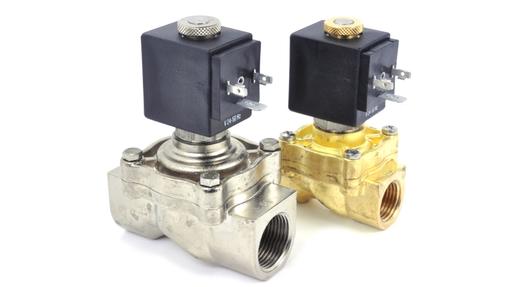
Two solenoid valves can share the same size, function and coil, yet one will run for years and the other fail within weeks. Very often the difference is the body material. A valve body that is incompatible with the media corrodes, leaks or contaminates the process; one that is over-specified simply costs more than it needs to.
This guide compares the three main body material families, brass, stainless steel and engineering plastics, explains why seal choice matters just as much, and covers the approvals required for food, potable water and hazardous area applications. It applies equally to two-way, three-way and five-way solenoid valves.
Brass: The General-Purpose Choice
Brass is the most widely used solenoid valve body material. It machines well, is strong enough for high pressures, and is considerably cheaper than stainless steel. For neutral media it is usually the right answer.
Suited to: compressed air, inert gases, water, light oils, fuel oil and many fuel gases.
Avoid with: ammonia and ammonia-bearing media, which cause stress corrosion cracking; acids and strong alkalis; seawater and aggressive or chloride-rich water; and deionised or demineralised water, which leaches zinc from the brass. In some water supplies, standard brass can also suffer dezincification, where zinc is selectively removed, leaving a weak, porous body. Dezincification-resistant (DZR) brass is available for these conditions.
Nickel-plated brass is a useful middle ground. A nickel coating, sometimes called Niploy, improves resistance to corrosive atmospheres and mildly aggressive media at a lower cost than stainless steel. It is a popular choice for external installations, coastal sites and offshore control panels where the media is benign but the environment is not. Bear in mind that plating protects the surface; if it is damaged, the brass beneath is exposed.
Stainless Steel: Corrosion Resistance and Hygiene
Stainless steel bodies cost more than brass, but resist a far wider range of media, tolerate higher temperatures, and are easy to clean.
Suited to: steam and hot water, food and beverage, pharmaceutical and hygienic duties, demineralised and deionised water, many chemicals and solvents, sour gas, cryogenic liquids, and installations in corrosive or offshore environments.
Grades matter. 304 stainless steel (cast equivalent CF8) is suitable for most water, steam and general chemical duties. 316 stainless steel (CF8M) adds molybdenum, which greatly improves resistance to chlorides, so it is the standard choice for seawater, brine, chlorinated water, coastal and offshore sites, and many process chemicals. Most valves also use a magnetic stainless grade, such as 430F, for the core tube and plunger, because the solenoid needs a magnetic path to work.
Limits: stainless steel is not immune to everything. Hydrochloric acid, hot concentrated chlorides and some halogens can cause pitting or stress corrosion cracking, even in 316. For these, check compatibility carefully or consider a plastic or specialist alloy body.
Stainless steel is also the material of choice for cryogenic and oxygen service, where valves are supplied degreased and cleaned, and for high temperature steam valves such as the Uflow MCP and MCF series.
Plastic: Aggressive Chemicals at Low Pressure
Engineering plastic bodies come into their own where media would attack any metal. They are light, inexpensive and completely immune to electrochemical corrosion.
• PVC-U: water treatment, dilute acids and alkalis, and chlorinated water at ambient temperature. The lowest cost option, but limited to around 60°C.
• Polypropylene (PP): a wider range of acids, alkalis and some solvents than PVC, to around 80–90°C.
• PVDF: excellent resistance to strong acids, halogens, chlorine and many solvents, and suitable for high-purity water. Higher temperature capability than PVC or PP.
• PTFE: almost universally chemically inert, used for the most aggressive media.
Limits: plastic valves are generally limited to low pressures, typically a few bar to around 10 bar, and their pressure rating falls as temperature rises. They are unsuitable for steam, can be affected by UV in outdoor installations, are less tolerant of mechanical damage and pipe stress, and need careful consideration in hazardous areas, where a non-conductive body can build up static charge.
Typical applications include chemical dosing, water treatment, swimming pools, reverse osmosis and demineralised water plants, plating lines and laboratory systems.
Seals Matter as Much as the Body
A stainless steel body is no help if the seals are attacked by the media. The seals and diaphragm are usually the first parts to fail, so choose them with the same care.
| Seal material | Typical temperature range | Suited to | Avoid with |
|---|---|---|---|
| NBR (nitrile) | -10°C to +90°C | Air, water, mineral oils, fuels, inert gases | Steam, ozone, strong acids, many solvents |
| EPDM | -10°C to +140°C | Hot water, low pressure steam, glycols, many dilute acids and alkalis | Mineral oils, fuels and hydrocarbons |
| FKM (Viton) | -10°C to +130°C, higher on some valves | Oils, fuels, many chemicals and solvents, higher temperatures | Hot water and steam in many grades, ketones, ammonia |
| PTFE | -10°C to +180°C and beyond | Steam, aggressive chemicals, high pressures, food and cryogenic duties | Few chemical limits; less elastic, so may need a higher minimum pressure or a different valve design |
Ranges vary by manufacturer and valve design; always check the specific datasheet.
The classic mistake is fitting EPDM seals on a valve handling oil, or NBR on a hot water or steam line. Both will swell or harden and fail quickly. If in doubt, check the media against a chemical compatibility chart for both the body and the seal, or ask the supplier.
Material Selection by Application
| Application | Recommended body | Typical seal |
|---|---|---|
| Compressed air and inert gases | Brass | NBR or FKM |
| Mains water, cooling water | Brass (DZR where required) or stainless steel | NBR or EPDM |
| Potable water | WRAS-approved brass or stainless steel | WRAS-approved EPDM |
| Hot water and steam | Stainless steel | EPDM (low pressure steam) or PTFE |
| Fuel oil, light oils | Brass | NBR or FKM |
| Food, beverage and pharmaceutical | 316 stainless steel, food contact certified | PTFE or certified EPDM / FKM |
| Seawater, brine, offshore | 316 stainless steel | FKM or PTFE |
| Demineralised or deionised water | Stainless steel or PVDF | EPDM |
| Strong acids, chlorine, aggressive chemicals | PVDF or PTFE (low pressure); 316 stainless steel where compatible | FKM or PTFE |
| Cryogenic and oxygen service | Stainless steel, degreased | PTFE |
| Corrosive atmosphere, benign media | Nickel-plated brass | To suit media |
When two materials both suit the media, the deciding factors are usually pressure and temperature (which favour metal), cost (which favours brass), and the environment around the valve, as an external or offshore installation may justify stainless steel even for compressed air.
Approvals: Food, Potable Water and Hazardous Areas
For some applications, material compatibility is not enough on its own; the materials must also be certified.
Food contact. Valves in contact with food or beverages in the UK and EU must comply with Regulation (EC) 1935/2004, often referred to as MOCA. Compliant materials are tested to show they do not release harmful substances into the product. In practice this usually means a stainless steel body with certified seals. See our MOCA EC 1935/2004 resource for more detail.
Potable water. In the UK, fittings in contact with drinking water must comply with the Water Supply (Water Fittings) Regulations, usually demonstrated through WRAS approval. This covers both the body, where lead content in brass is a key concern, and the seals.
Hazardous areas. In ATEX zones, the body material affects more than corrosion. Metal bodies avoid the static risk associated with plastics, and the solenoid coil must carry the appropriate Ex certification. Many valves are available in brass, nickel-plated brass and 316 stainless steel with ATEX Ex d coils, so the body can still be chosen for the media. See our ATEX and hazardous area resource.
Summary
Brass is the economical, general-purpose choice for air, water, oils and gases, with nickel-plated brass adding protection against corrosive surroundings. Stainless steel, 316 in particular, handles steam, food, chlorides, aggressive media and harsh environments. Plastics such as PVDF and PTFE suit strong chemicals at low pressure. Whatever the body, match the seals to the media and temperature, and check whether food contact, potable water or ATEX approval is required.
Measure Monitor Control supplies solenoid valves in brass, nickel-plated brass and 304 and 316 stainless steel, with NBR, EPDM, FKM and PTFE seal options. Browse our solenoid valve FAQs, or speak to our team about material compatibility for your application.