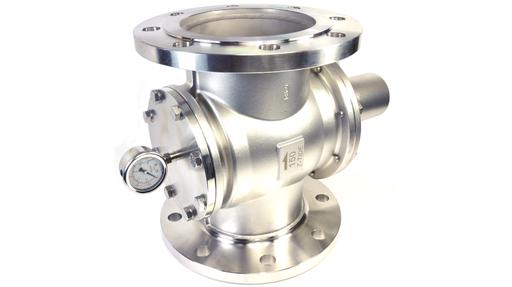
Pressure sustaining valves are among the most frequently misunderstood devices in pressure control. They look much like pressure reducing valves, they are often specified alongside them, and the two are regularly confused. Yet they do the opposite job, and installing one where the other is needed can leave a pump unprotected or a process starved of pressure.
This guide explains what a pressure sustaining valve is, how it differs from a pressure reducing valve, how the mechanism works, where it is used, and what to consider when selecting one.
What Does a Pressure Sustaining Valve Do?
A pressure sustaining valve maintains a minimum pressure on its inlet, or upstream, side regardless of what is happening downstream. It stays closed until upstream pressure reaches its set point, then opens only as far as needed to hold that pressure while passing the surplus flow downstream.
If downstream demand rises sharply, for example when a large consumer opens or a pipe bursts, the valve throttles back rather than letting upstream pressure collapse. The upstream section of the system is therefore guaranteed a minimum working pressure at all times.
The same device is often called a back pressure valve, back pressure regulator or minimum pressure valve. The terms are largely interchangeable, although "back pressure regulator" tends to be used in process and gas applications and "pressure sustaining valve" in water and pumping systems.
Pressure Sustaining vs Pressure Reducing Valves
The essential difference is which side of the valve is being controlled.
| Pressure sustaining valve | Pressure reducing valve | |
|---|---|---|
| Controls | Upstream (inlet) pressure | Downstream (outlet) pressure |
| At rest / low pressure | Closed | Open |
| Opens when | Inlet pressure rises above set point | Outlet pressure falls below set point |
| Purpose | Guarantee a minimum pressure upstream | Limit the maximum pressure downstream |
A pressure reducing valve protects equipment downstream from excessive pressure. A pressure sustaining valve protects the system upstream from losing pressure. Our article on pressure sustaining vs pressure reducing valves covers the distinction and common misspecification scenarios in more detail.
How Does a Pressure Sustaining Valve Work?
Pressure sustaining valves come in two main designs: direct acting and pilot operated.
Direct Acting
In a direct acting valve, inlet pressure acts on a diaphragm or piston that is held against the seat by an adjustable spring. When inlet pressure exceeds the spring force, the valve lifts and passes flow; as pressure falls, the spring closes it again. Turning the adjustment screw changes the spring force and therefore the set point. Direct acting valves are simple, compact and respond quickly, which makes them well suited to smaller pipe sizes and lower flows.
Pilot Operated
For larger lines and higher flows, a pilot operated design gives tighter control. A small pilot valve senses inlet pressure and controls the pressure in the chamber above the main valve's diaphragm or piston. The main valve is normally closed, held shut by its own line pressure acting in that chamber. The opening sequence is:
1. Inlet pressure is below the set point. The pilot is closed, the control chamber is pressurised, and the main valve stays shut.
2. Inlet pressure reaches the set point. The pilot begins to open, venting the control chamber.
3. With chamber pressure reduced, inlet pressure lifts the main valve and surplus flow passes downstream.
4. If downstream demand pulls inlet pressure down, the pilot closes, the chamber repressurises, and the main valve throttles back to restore the set pressure.
Because the pilot does the sensing and the line pressure does the work, pilot operated valves hold their set point accurately across a wide range of flows, with very little pressure variation as flow changes.
Where Are Pressure Sustaining Valves Used?
- Pump protection - Installed on a pump discharge, a sustaining valve holds back pressure so the pump operates within its curve. It prevents run-out and cavitation when downstream demand suddenly increases, for example on start-up into an empty main. Our article on pump protection with pressure sustaining valves covers sizing and installation in detail.
- Parallel pump systems - Where several pumps feed a common header, sustaining valves stop one pump from overpowering another and keep each operating at a stable point.
- Filter backwash circuits - Backwashing a filter diverts a large flow to drain. A sustaining valve on the outlet ensures the filter retains enough pressure for effective cleaning and that the supply to the rest of the system is not lost.
- Minimum process pressure - Many processes, spray systems and instruments need a guaranteed minimum pressure to function correctly. A sustaining valve ensures that upstream users take priority over downstream ones.
- Elevated zones and water distribution - In supply networks, sustaining valves keep pressure in higher zones or priority areas when demand in lower areas peaks.
Selecting a Pressure Sustaining Valve
- Set pressure range: Choose a spring or pilot range that places the required set point near the middle of the adjustable span, where control is most stable. Very low set points need a valve with a large diaphragm for accuracy.
- Flow capacity (Kv/Cv): Size the valve on the flow it must pass at the set pressure, not simply on the pipe size. An oversized valve operates close to its seat, which leads to instability, chatter and accelerated wear.
- Body material and media: Match the body and elastomers to the fluid and temperature. Stainless steel suits corrosive media and hygienic applications; cast or ductile iron and bronze are common for water. PTFE seals extend some valves to steam service.
- Connection type and size: Screwed BSP connections are typical for smaller valves, with flanged connections for larger lines.
- Body pressure rating: Confirm the valve's maximum body pressure exceeds the highest pressure the system can generate, including surge.
The Z-Tide Pressure Sustaining Range
Z-Tide has manufactured pressure control valves in Taiwan since 1971, and its sustaining range supplied by Measure Monitor Control covers set pressures from 0.02 bar to 10 bar.
| Model | Type | Set pressure range | Sizes | Body | Typical use |
|---|---|---|---|---|---|
| P04 | Pilot operated, piston | 0.3–4 bar, 2–8 bar | DN50–DN300 flanged | Cast iron, ductile iron, bronze, 304 or 316 stainless | Pump protection, larger liquid lines |
| P09 | Direct acting, balanced piston | 1–5 bar, 4–10 bar | 1/2"–2" BSP | 316 stainless | General liquids and gases; steam to 180°C with PTFE seals |
| P26 | Direct acting, large diaphragm | 0.2–1.5 bar | 1/2"–2" BSP, DN15–DN50 flanged | 316 stainless | Low pressure control |
| P43 | Direct acting, large diaphragm | 0.02–0.2 bar | 1/2"–2" BSP, DN15–DN50 flanged | 316 stainless | Micro pressure control |
The P04 mounts its sustaining pilot directly on a common valve body, eliminating the external pilot pipework found on traditional designs. This reduces the risk of external leakage and installation damage, and the pilot or internal parts can be replaced quickly on site. The direct acting models are rated to 25 bar body pressure, and the P26 and P43 are special order.
To Summarise
A pressure sustaining valve holds a minimum pressure upstream of itself, opening only to pass surplus flow. It is the opposite of a pressure reducing valve, which controls downstream pressure. Direct acting designs suit smaller lines and low pressures; pilot operated designs give accurate control at higher flows. Select on set pressure range, flow capacity, materials, connections and body rating rather than pipe size alone.Browse the full range of pressure sustaining valves at Measure Monitor Control, or contact our team to request a specification review for your application. You can also explore our wider pressure regulation range.