Hydrogen is among the most technically demanding media that industrial valves are asked to handle. Its physical properties create challenges that do not exist with most other gases: it is the smallest molecule in existence, it attacks certain metals at a molecular level over time, it ignites across an exceptionally wide concentration range, and it burns with a flame that is invisible to the naked eye. Valves that work reliably with nitrogen or natural gas cannot simply be repurposed for hydrogen service.
This guide covers the properties of hydrogen that matter for valve selection, the types of valves used in hydrogen systems, materials, sealing considerations, testing requirements, applicable standards, and the key parameters that need to be defined at the specification stage.
Why Hydrogen Demands Specialist Valve Design
Before selecting a valve type, it is worth understanding what makes hydrogen behave differently from other gases, because these properties drive every major design decision.
Molecular Size
Hydrogen (H2) is the smallest molecule in existence. This allows it to permeate through materials that would contain other gases without difficulty. It passes into and through certain elastomers. It diffuses into metals at a microscopic level. These properties mean that leak-tightness requirements and material compatibility that are acceptable for compressed air or nitrogen are frequently insufficient for hydrogen.
Flammability Range
Hydrogen has a flammability range of 4% to 75% by volume in air, and a detonation range of approximately 18% to 59%. By comparison, natural gas has a flammability range of roughly 5% to 15%. This exceptionally wide range means that even small leaks carry significant risk, and that fugitive emissions requirements in hydrogen service are considerably more stringent than in most other gas applications.
Invisible Flame
Hydrogen burns with a colourless, nearly invisible flame. This has direct implications for the severity of any ignition event from a valve leak, since the hazard is not visually detectable in the way that many hydrocarbon fires are.
Temperature Range
Hydrogen systems span an extreme temperature range: gaseous hydrogen in high-pressure storage and distribution operates at ambient temperatures and above, while liquid hydrogen (LH2) exists at -253°C (-423°F), within four degrees of absolute zero. This places exceptional demands on materials in cryogenic hydrogen service, where virtually all standard engineering materials become dangerously brittle.
High Pressure
Hydrogen fuelling and storage systems commonly operate at 350 to 700 bar for vehicle applications, and high-pressure industrial storage operates across a similarly wide range. The combination of high pressure and small molecular size amplifies the permeation and embrittlement risks significantly.
Hydrogen Embrittlement: The Critical Material Challenge
Hydrogen embrittlement is the most important material consideration in hydrogen valve design, and one that is frequently underestimated. When hydrogen atoms diffuse into the lattice structure of a metal, they reduce its ductility and fracture toughness. The result is that components which would normally deform plastically before failure instead fracture suddenly and without warning under loads that would otherwise be safe.
Hydrogen embrittlement is not a surface phenomenon. It occurs throughout the depth of material exposed to hydrogen, and its severity increases with hydrogen pressure, temperature, and the stress state of the material. Martensitic and ferritic steels are particularly susceptible. High-strength carbon steels, which might otherwise be the natural choice for high-pressure pressure-containing parts, are often unsuitable for hydrogen service precisely because their strength is achieved through microstructures that are vulnerable to embrittlement.
Austenitic stainless steels, particularly 316L and 304L, offer significantly better resistance to hydrogen embrittlement and are the most widely specified body and trim materials for hydrogen service. Aluminium alloys are used in some applications. Nickel alloys provide excellent resistance but at considerably higher cost.
This is not a one-time selection decision. Components that perform adequately at the start of service may degrade over time as hydrogen exposure accumulates. Valve bodies, bonnets, stems, springs, and fasteners all need to be evaluated for long-term compatibility with the specific hydrogen partial pressure and temperature conditions of the duty.
The effects of hydrogen on mechanical properties of materials are detailed in ISO/TR 15916:2015, which provides essential reference guidance for specifying materials in hydrogen service.
Sealing in Hydrogen Service
Sealing is one of the most technically challenging aspects of hydrogen valve design. The small molecular size of hydrogen means that leak paths that would be inconsequential with larger gas molecules become significant. Non-metallic seals present particular challenges.
Elastomer Selection
Many standard elastomers are not suitable for hydrogen service. Hydrogen permeates through certain elastomers at rates that would be unacceptable, and some materials suffer degradation from hydrogen exposure over time. High-durometer (shore hardness) compounds generally perform better. EPDM, FKM (Viton), and PTFE are among the materials that can be formulated for hydrogen service, but the specific grade and compound must be verified, not assumed from the generic material family.
Rapid Gas Decompression
In high-pressure hydrogen systems, rapid decompression events can cause absorbed hydrogen within elastomers to come out of solution faster than it can diffuse out, causing internal blistering and catastrophic seal failure. This phenomenon must be considered when specifying seals for high-pressure hydrogen systems. NORSOK M-710 and ISO 23936 provide the relevant testing standards for rapid gas decompression (RGD) resistance.
Metal-to-Metal Seating
For the most demanding hydrogen duties, particularly at high pressures, metal-to-metal seat designs eliminate the reliance on elastomeric soft seals at the primary closure. Metal-seated ball valves and globe valves with Stellite or hardened stainless trim provide durable, hydrogen-compatible shut-off.
Stem Packing
The valve stem is a primary path for fugitive emissions. In hydrogen service, stem packing must provide long-term leak-tight performance against a highly permeable gas. Live-loaded packing designs that maintain consistent compression as the packing wears are preferred. Bellows-sealed designs, which eliminate the stem packing entirely by using a metal bellows to seal the stem, provide the most reliable fugitive emissions performance for critical applications.
Types of Hydrogen Valves
Pressure Regulators
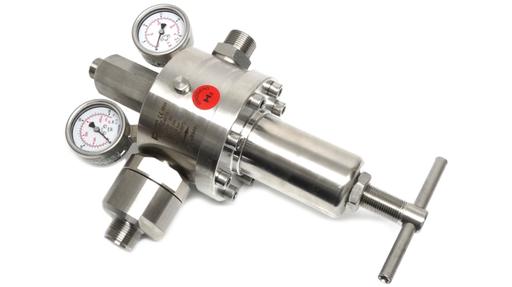
Pressure regulation is required wherever hydrogen pressure needs to be stepped down from storage or supply pressure to process or delivery pressure. In gaseous hydrogen systems, this typically involves reducing from high storage pressures (up to 400 bar or more) to working pressures. The R31000 high-pressure regulator from ID Insert Deal, available from Measure Monitor Control, is rated to 400 bar inlet pressure in 316L stainless steel, with elastomer options verified for hydrogen service. It is certified to PED and ATEX standards, and available as a pilot-operated design for external pressure control duties.
Ball Valves
Ball valves are the most commonly used shut-off valve in hydrogen systems. Quarter-turn operation makes them fast to operate and easy to actuate. For hydrogen service, trunnion-mounted designs are preferred for larger bore applications as they provide more consistent seating load than floating ball designs. Double-block-and-bleed configurations are used where positive isolation and leak verification are required. Key requirements include verified elastomer compatibility, provisions to prevent trapped hydrogen in the ball cavity from causing overpressure when the valve is closed, and antistatic provisions.
Globe Valves
Globe valves provide throttling control and are used in flow control duties on hydrogen lines. Bellows-sealed globe valves are particularly suited to hydrogen service because they eliminate stem packing as a fugitive emission path. The disc and seat arrangement provides reliable shut-off, and Stellite hard-facing on seating surfaces is standard for hydrogen duties where wear resistance is required.
Check Valves
Check valves in hydrogen systems prevent reverse flow, protecting compressors, storage vessels, and other equipment from backflow. Spring-loaded check valves are preferred in hydrogen service over swing check designs, as they provide more consistent closure and are less susceptible to chatter at low differential pressures.
Needle Valves
Needle valves provide precise, fine-adjustment flow control and are widely used on instrumentation and analyser supply lines in hydrogen systems. Their small bore and precision trim make them well suited to the metered supply of hydrogen to analytical and control equipment.
Safety Relief Valves
Safety relief valves are mandatory on any pressure-containing hydrogen system. They protect against overpressure from blocked outlets, thermal expansion, compressor runaway, and process upsets. For hydrogen service, relief valves must be fully enclosed with discharge routed to a safe location. Measure Monitor Control supply pressure relief valves suited to gas service applications including hydrogen.
Solenoid Valves
Solenoid valves provide electrically actuated shut-off and control in hydrogen systems, used as emergency shut-off valves, as part of gas safety interlock systems, and in automated process control. For hydrogen service, solenoid valve bodies must be compatible with dry gas service, as hydrogen provides no lubrication to moving parts. ATEX-rated coil and enclosure designs are required in hazardous areas.
Standards and Codes for Hydrogen Valves
The standards landscape for hydrogen valve design and testing is still developing, reflecting the relative immaturity of large-scale hydrogen infrastructure compared to more established gas industries. The principal standards currently in use are:
ISO 19880-3:2018 covers gaseous hydrogen fuelling stations, Part 3 of which specifies valve requirements for hydrogen fuelling infrastructure. It addresses design, materials, performance, and testing requirements.
ASME B31.12 is the US standard for hydrogen piping and pipelines, covering design, materials, fabrication, inspection, and testing. It is frequently referenced as the basis for process hydrogen system design.
ISO/TR 15916:2015 provides the basic technical considerations for the safety of hydrogen systems, including detailed guidance on material selection relative to hydrogen embrittlement.
API 600 and API 608 provide design and testing standards for steel gate valves and metal ball valves respectively, and are widely referenced for hydrogen service valves in petrochemical applications.
EN 13463 covers non-electrical equipment for use in potentially explosive atmospheres, relevant to valve selection in ATEX-classified hydrogen environments.
Testing of Hydrogen Valves
Standard valve testing procedures used across most industries are not adequate for hydrogen service. The small molecular size of hydrogen means that test results obtained with water or compressed air do not reliably predict hydrogen leak performance.
Helium Testing
Testing with helium is now considered the minimum baseline for hydrogen service valves. Helium has a molecular size closer to hydrogen than nitrogen or compressed air, and provides a much more representative test of leak-tight performance. A helium mass spectrometer allows leak rate measurement to a level of precision that standard pressure decay testing cannot achieve.
Hydrogen Test Media
Where facilities and safety arrangements allow, testing with actual hydrogen provides the most direct assessment of valve performance. This is particularly important for evaluating seal and packing performance, which may behave differently with hydrogen than with helium.
Extended Hold Tests
High-pressure extended hold tests are recommended beyond the minimum durations specified in API 598 or ISO 5208. Hydrogen permeation through materials and seals is time-dependent: a valve that shows no leakage at the conclusion of a standard test duration may show leakage if the hold time is extended.
Fugitive Emissions Testing
ISO 15848 or equivalent protocols should be considered for valves in hydrogen service where stem emissions are a concern, particularly for valves cycling frequently.
Key Selection Criteria
When specifying valves for hydrogen service, the following parameters must be established before a valve can be correctly specified:
- Phase and Pressure: Is the hydrogen gaseous or liquid? What is the maximum and minimum operating pressure? High-pressure gaseous hydrogen and liquid hydrogen are very different duties with largely non-overlapping design requirements.
- Temperature Range: Minimum and maximum operating temperatures including transient conditions. For ambient temperature gaseous service, austenitic stainless steel is generally appropriate. Liquid hydrogen at -253°C requires specialist cryogenic valve design.
- Function: Isolation, throttling, pressure regulation, pressure relief, check function, or flow control each point to a different valve type.
- Leak-Tightness Requirement: Define this quantitatively, not as a general statement. It directly determines the testing protocol and the valve design that will be acceptable. Both internal (seat) and external (fugitive) leakage limits must be specified.
- Cycling Frequency: Valves that cycle frequently face different wear and fatigue considerations from those used only for periodic isolation. Seat and seal wear, bellows fatigue, and stem packing performance over time are all influenced by cycle count.
- Actuation: Manual, solenoid, or pneumatically actuated? In ATEX hazardous areas, all electrical and pneumatic components must carry appropriate certification for the zone classification of the installation.
- Standards Compliance: Which standards govern the installation? ISO 19880-3, ASME B31.12, PED, and applicable national codes should be confirmed at the specification stage.