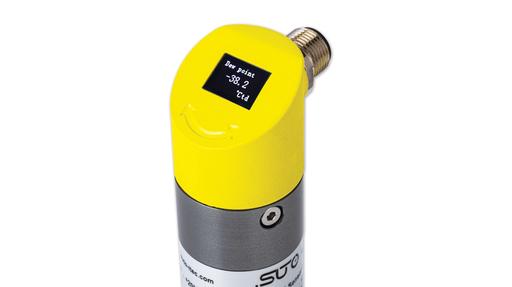
A compressed air dryer is one of the most important pieces of equipment in the compressor house, and one of the least checked. Dryers rarely fail suddenly. Desiccant degrades, filters clog and refrigerant circuits lose efficiency gradually, and the first sign of trouble is often water in the pipework or a failed valve on the production line.
Dew point measurement is the only direct way to confirm that a dryer is doing its job. This guide explains why verification matters, what dew point each type of dryer should achieve, how and where to measure, and what to check when the dew point is higher than it should be.
Why Verify Dryer Performance?
- ISO 8573 compliance and audit evidence - Where compressed air must meet an ISO 8573-1 water class, for example in food, beverage and pharmaceutical production, a dryer's nameplate rating is not evidence that the air achieves it. Auditors expect measured, recorded dew point data from a calibrated instrument. Our ISO 8573 guide covers the standard in full.
- Preventing moisture damage downstream - Water in compressed air corrodes pipework and receivers, washes lubrication out of pneumatic valves and cylinders, freezes in exposed lines, and contaminates product. Catching a rising dew point early is far cheaper than dealing with the consequences.
- Confirming work after servicing - After a desiccant change, filter replacement or refrigeration repair, a dew point check confirms the dryer has returned to specification before the system goes back into normal service.
- Energy efficiency - Desiccant dryers that purge more than necessary waste compressed air. Dew point-dependent switching, which extends the drying cycle while dew point remains within limits, relies on accurate continuous measurement.
Dryer Types and Their Target Dew Points
Before you can verify a dryer, you need to know what it should achieve. All figures below are pressure dew points. If you are unsure of the difference, see our guide to pressure dew point vs atmospheric dew point.
| Dryer type | How it works | Typical target PDP | ISO 8573-1 water class |
|---|---|---|---|
| Refrigerant | Cools air to condense moisture, then reheats it | +3°C | Class 4 |
| Desiccant (standard) | Adsorbs moisture onto desiccant beds, regenerated by purge air or heat | -40°C | Class 2 |
| Desiccant (ultra-dry) | As above, with deeper drying | -70°C | Class 1 |
| Membrane | Water vapour permeates through hollow fibre membranes | Variable; depends on flow and purge, often -20°C to -40°C | Typically Class 2–3 |
Always check the manufacturer's rated dew point for the specific dryer, and the conditions it applies to. Refrigerant dryer ratings in particular assume a specific inlet temperature, ambient temperature and flow; a dryer running above its rated inlet temperature or flow will not reach its nameplate dew point.
Continuous Monitoring or Portable Spot Checks?
A fixed inline transmitter installed permanently at the dryer outlet gives a continuous record of dew point. It can trigger an alarm the moment dew point exceeds a limit, log data for ISO 8573 audit evidence, and feed a building management or SCADA system. For any dryer serving a quality-critical process, continuous monitoring is the recommended approach, because it catches intermittent problems such as a desiccant tower failing to regenerate on one cycle that a periodic check would miss.
A portable or handheld meter is used for spot checks: commissioning a new dryer, confirming performance after servicing, checking dryers that have no fixed sensor, and verifying that fixed transmitters are still reading correctly between calibrations. One portable meter can serve every dryer on a site.
Most sites benefit from both: fixed transmitters on critical dryers, and a portable meter for everything else.
Where to Measure
- At the dryer outlet, after any after-filter - To verify the dryer itself, measure as close to its outlet as practical, downstream of the dust or particulate after-filter fitted to most desiccant dryers. Never measure upstream of the dryer or after the aftercooler: the air there is saturated, and liquid water can damage or saturate the sensor.
- From the top or side of the pipe - Take the measurement or sample from the top or side of a horizontal pipe, not the bottom, where any liquid water collects. Avoid dead legs, where stagnant air does not represent the flow.
- Allow for desiccant tower switchover - Twin-tower desiccant dryers produce a brief dew point fluctuation each time the towers switch. A single reading taken at the wrong moment can be misleading in either direction, which is another reason continuous logging gives a truer picture than a spot check.
- Give the sensor time to settle - Dew point sensors take time to stabilise, particularly at very low dew points, and when a portable meter is moved from ambient air into a dry line. Purge the sample point before connecting, use short stainless steel or PTFE sample lines, and wait for the reading to stop drifting before recording it.
- Check points of use too - The dryer outlet tells you how the dryer is performing. A second measurement at a critical point of use tells you whether the air is staying dry through the distribution network.
When Dew Point Is Higher Than Specification
First, rule out the measurement. Check the sensor is in calibration, the reading has stabilised, the sample point is correct and free of leaks, and the reading is being compared on the right basis (PDP, not ADP). Then look at the dryer.
Desiccant Dryers
• Desiccant saturation or degradation - Desiccant loses capacity with age and is permanently damaged by oil and liquid water. If dew point has risen gradually over months, the desiccant may be due for replacement.
• Pre-filter failure or bypass - A blocked, damaged or bypassed coalescing pre-filter lets oil and liquid water reach the desiccant bed, coating it and destroying its adsorption capacity. Check pre-filter differential pressure and drains.
• Regeneration failure - In heatless dryers, a blocked purge valve or silencer, or an incorrect purge setting, leaves a tower under-regenerated. In heated dryers, a failed heater or blower has the same effect. A dew point that spikes after every switchover often points here.
• Switching valve faults - A leaking or sticking changeover valve can let wet air bypass the drying tower.
Refrigerant Dryers
• High inlet or ambient temperature - The dryer is working beyond its rated conditions, often seasonally in summer.
• Fouled condenser - Dust on an air-cooled condenser reduces cooling capacity.
• Failed condensate drain - Water separated in the dryer is carried back into the air stream.
• Overload - Flow has grown beyond the dryer's capacity since it was installed.
• Refrigerant leak or compressor fault - Requires a refrigeration engineer.
Membrane Dryers
Running above rated flow or with reduced purge both raise the outlet dew point, and oil contamination of the membrane fibres permanently reduces performance.
SUTO Instruments for Dryer Verification
Measure Monitor Control supplies the SUTO iTEC dew point range, which covers every dryer type and both verification approaches.
Continuous monitoring
Fixed transmitters matched to the dryer type: the S215 for refrigerant dryers, the S211 measuring to -60°C for standard desiccant dryers, and the S220 measuring to -100°C for ultra-dry systems targeting Class 1. The S305 dew point monitor combines sensor, display and alarm in one unit for standalone dryer monitoring. SUTO sensors connect to SUTO displays and data loggers to record dew point history for audit purposes.
Portable verification
The S520 smart dew point meter is a handheld instrument for spot checks at dryer outlets and points of use, commissioning and post-service checks, and verifying fixed transmitters between calibrations.
For help choosing the right instrument, see our guide on how to select a dew point sensor for compressed air.
In Summary
Dew point measurement is the only direct way to verify that a compressed air dryer is meeting its specification. Know the target pressure dew point for each dryer type, measure at the dryer outlet after any after-filter, and give the sensor time to settle. Use fixed transmitters for continuous monitoring and audit records on critical dryers, and a portable meter for spot checks and post-service verification. When dew point rises, rule out the measurement first, then work through the likely causes for that dryer type.
Browse our range of SUTO dew point instruments, or request a compressed air measurement consultation to discuss monitoring your dryers.