Two engineers can look at the same compressed air and quote dew points 20°C apart, and both be correct. One is quoting pressure dew point, the other atmospheric dew point. The distinction is simple once understood, but it is one of the most common causes of specification errors in compressed air quality, particularly for engineers moving from general humidity measurement into compressed air.
This guide explains what each term means, how to convert between them, which one ISO 8573 uses, and the practical consequences of getting it wrong.
What Dew Point Is, and Why Pressure Changes It
Dew point is the temperature at which the water vapour in a gas becomes saturated and begins to condense into liquid. Below 0°C, moisture deposits as frost rather than liquid water, and the correct term is frost point, although "dew point" is used for both in everyday practice.
The dew point depends on the partial pressure of water vapour in the gas. When air is compressed, its total pressure rises and so does the partial pressure of the water vapour it contains. At 7 bar(g), the air is roughly eight times as dense as at atmospheric pressure, and so is the water vapour. The air is now much closer to saturation, which means it will condense at a higher temperature.
This is why compressors produce so much condensate. Atmospheric air that is nowhere near saturation becomes saturated once compressed and cooled in the aftercooler, and liquid water drops out. It is also why compressed air must be dried before distribution: any point in the system cooler than the pressure dew point will collect water.
Pressure Dew Point and Atmospheric Dew Point Defined
Pressure dew point (PDP) is the temperature at which moisture will condense at the system's operating pressure. It is the figure that tells you whether water will form in your pipework, receivers, valves and tools. If the coldest point in the system is above the PDP, the air stays dry.
Atmospheric dew point (ADP) is the dew point of the same air once it has been expanded to atmospheric pressure. Expansion lowers the partial pressure of the water vapour, so the ADP is always lower than the PDP. The moisture content has not changed; only the pressure at which it is being described has.
Both figures describe exactly the same quantity of water. The difference is purely the pressure basis, which is why a dew point figure is meaningless unless the pressure it refers to is stated.
Converting Between PDP and ADP
The conversion follows from the partial pressure of water vapour, which falls in direct proportion to the total pressure when air is expanded. The method is:
1. Find the saturation vapour pressure of water at the pressure dew point.
2. Multiply it by the ratio of atmospheric pressure to absolute line pressure.
3. Find the temperature at which that reduced vapour pressure is saturated. This is the atmospheric dew point.
Worked example at 7 bar(g). A refrigerant dryer delivers air at +3°C PDP at 7 bar(g), which is 8.01 bar absolute.
• The saturation vapour pressure at +3°C is approximately 7.58 hPa.
• Expanded to atmospheric pressure (1.013 bar), the vapour pressure becomes 7.58 × 1.013 ÷ 8.01 ≈ 0.96 hPa.
• The temperature at which 0.96 hPa is saturated is approximately -21°C.
So +3°C PDP at 7 bar(g) is equivalent to around -21°C ADP. The same air, described two ways, gives figures 24°C apart.
The table below gives typical equivalents at 7 bar(g). The gap widens as line pressure increases: at 10 bar(g), +3°C PDP corresponds to around -24°C ADP.
| Pressure dew point at 7 bar(g) | Approximate atmospheric dew point |
|---|---|
| +10°C | -16°C |
| +3°C | -21°C |
| -20°C | -40°C |
| -40°C | -57°C |
| -70°C | -83°C |
Values calculated from standard saturation vapour pressure formulae, over ice below 0°C. Results vary slightly with the formula used.
Which Dew Point Does ISO 8573 Use?
ISO 8573-1 defines its water vapour classes by pressure dew point. This is unambiguous: the class refers to the dew point of the air at the pressure at which it is measured.
| ISO 8573-1 water class | Pressure dew point | Typical dryer |
|---|---|---|
| Class 1 | ≤ -70°C | Desiccant |
| Class 2 | ≤ -40°C | Desiccant |
| Class 3 | ≤ -20°C | Desiccant or membrane |
| Class 4 | ≤ +3°C | Refrigerant |
| Class 5 | ≤ +7°C | Refrigerant |
| Class 6 | ≤ +10°C | Refrigerant |
Classes 7 to 9 cover liquid water content rather than dew point, and Class 0 is a level specified by the user that must be stricter than Class 1. Our ISO 8573 air purity guide covers the full standard, including particle and oil classes.
Why Getting It Wrong Matters
- Under-specified dryers - A process needs -20°C PDP, but the requirement is written as "-20°C dew point" without stating the basis. A refrigerant dryer delivering around -21°C ADP appears to meet it and is accepted. In service, the air is only dried to +3°C PDP, and any pipework that falls below that temperature, such as an external run in winter, collects water.
- Over-specified dryers - The opposite error is costly too. Specifying -40°C PDP when -40°C ADP (around -20°C PDP at 7 bar) was intended can mean a heatless desiccant dryer where a cheaper option would do, with higher capital cost and purge air consumption for the life of the plant.
- Misread instruments - A portable meter sampling at atmospheric pressure reports ADP. If that figure is compared directly against a PDP specification, a dryer that is failing can appear to be performing well, by a margin of 20°C or more. When verifying a dryer, measure at line pressure, or make sure the instrument converts to PDP using the correct line pressure.
The simplest safeguard is to always state the basis and pressure: "+3°C PDP at 7 bar(g)", never just "+3°C".
Reading SUTO Dew Point Sensor Outputs
SUTO dew point sensors installed inline measure at line pressure, so their primary reading is pressure dew point, normally shown in °C Td. This can be compared directly against ISO 8573-1 water classes and dryer specifications without conversion.
Depending on the model and configuration, SUTO instruments can also report other moisture units such as atmospheric dew point or moisture content in ppmV. To convert accurately, the instrument needs the correct line pressure, either from an integral pressure sensor, as on variants of the S220, or from a pressure value entered during setup. If line pressure changes significantly in service and the sensor uses a fixed setting, converted values will be inaccurate, even though the measured PDP remains correct.
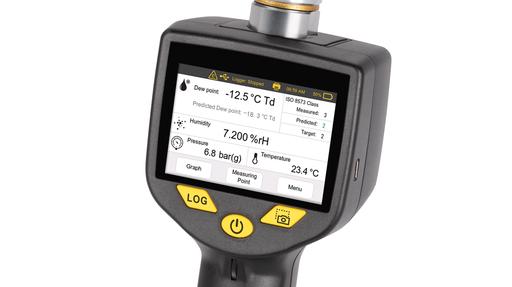
When using the S520 handheld dew point meter for spot checks, confirm whether the measurement is taken at line pressure or after expansion, and set the display basis accordingly before comparing readings with a specification. For guidance on choosing an instrument, see our article on how to select a dew point sensor for compressed air.
In Summary
Pressure dew point is the condensation temperature at line pressure; atmospheric dew point is the same air expanded to atmospheric pressure, and is always lower. At 7 bar(g), +3°C PDP is around -21°C ADP. ISO 8573-1 uses pressure dew point, and so should every dryer and instrument specification. Always state the basis and the pressure, and make sure any instrument converting between the two is using the correct line pressure.
Browse our range of dew point measurement instruments, or speak to our measurement specialists about verifying the dew point in your compressed air system.