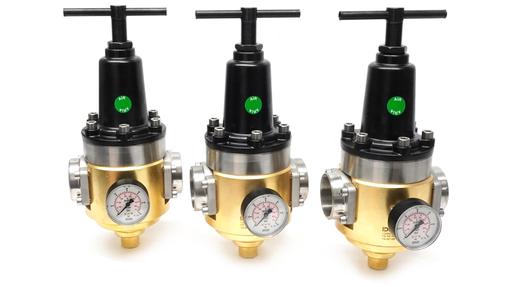
Pressure sustaining valves (PSVs) and pressure reducing valves (PRVs) are often built on the same body, use similar pilots and springs, and sit in the same section of a catalogue. It is no surprise that engineers regularly confuse them. But they control opposite sides of the valve, and fitting the wrong one can leave downstream equipment exposed to excess pressure or a pump running off its curve.
This guide explains how each valve works, compares them side by side, and walks through worked examples and common misspecification scenarios so you can be confident you are specifying the right one.
How Each Valve Works
The simplest way to tell the two apart is to ask which pressure the valve is watching.
A pressure reducing valve watches its outlet. It is normally open and throttles closed as downstream pressure rises towards its set point. Whatever the inlet pressure does, the outlet is held at or below the set pressure. Its job is to protect everything downstream from too much pressure.
A pressure sustaining valve watches its inlet. It is normally closed and only opens once upstream pressure exceeds its set point, passing surplus flow downstream. However much demand there is downstream, the inlet is held at or above the set pressure. Its job is to guarantee a minimum pressure upstream. For a full explanation of the mechanism, see our guide to what a pressure sustaining valve is and how it works.
A useful way to remember it: a reducing valve sets a ceiling on the pressure after it, a sustaining valve sets a floor on the pressure before it.
| Pressure sustaining valve | Pressure reducing valve | |
|---|---|---|
| Control point | Upstream (inlet) pressure | Downstream (outlet) pressure |
| Default position | Normally closed | Normally open |
| Opens when | Inlet pressure rises above set point | Outlet pressure falls below set point |
| Pilot sensing | Pilot senses inlet pressure | Pilot senses outlet pressure |
| Protects | The system upstream | The equipment downstream |
| Typical applications | Pump discharge, parallel pumps, filter backwash, priority supply | Mains supply to plant, process feed, gas and air supply to equipment |
| Common body materials | Cast iron, ductile iron, bronze, stainless steel | Cast iron, ductile iron, bronze, brass, stainless steel |
Because many manufacturers build both functions on the same main valve body, flow capacity (Cv/Kv) is broadly similar for the same size of valve. The difference lies in the pilot or spring arrangement and which side of the valve it senses, not in the body itself. Always size each valve on the flow it must pass at its set pressure, rather than assuming the line size is correct.
Worked Examples
When You Need a Pressure Reducing Valve
Reducing mains supply to process pressure - A site water supply arrives at 8 bar, but a washdown system and its hoses are rated for 4 bar. A PRV set at 4 bar holds the outlet at that pressure regardless of fluctuations in the mains. The concern is too much pressure downstream, so the reducing valve is the right choice.
Supplying gas or compressed air to equipment - A burner, analyser or pneumatic instrument needs a stable supply well below line pressure. A PRV delivers that steady, lower outlet pressure.
When You Need a Pressure Sustaining Valve
- Protecting a pump on start-up - A centrifugal pump discharges into a long, empty main. With no back pressure, it runs far out on its curve, drawing excess power and risking cavitation. A PSV on the discharge stays closed until the pump has built pressure, then opens progressively, keeping the pump within its operating range.
- Maintaining minimum pressure for downstream instruments - A sampling line and its instruments are fed from a header that also supplies a large, intermittent consumer. When the large consumer draws heavily, header pressure collapses and the instruments lose supply. A PSV ahead of the large consumer holds the header at its minimum working pressure, so the instruments are always served first.
Common Misspecification Scenarios
- A PRV fitted where a PSV was needed - On a pump discharge, a reducing valve opens fully whenever downstream pressure is low, which is exactly when the pump needs back pressure. The pump runs out on its curve, with high power draw, vibration and cavitation damage to the impeller.
- A PSV fitted where a PRV was needed - On a supply to low-rated equipment, a sustaining valve does nothing to limit outlet pressure. Once open, downstream pressure is unregulated and can rise close to inlet pressure, overpressurising hoses, seals and instruments.
- A valve installed in the wrong orientation - Both valves are directional. Installed backwards, the pilot senses the wrong side and the valve either fails to open or fails to control. Always check the flow arrow on the body.
- Confusing a sustaining valve with a relief valve - A sustaining valve controls pressure continuously in line. A pressure relief valve is a protective device that opens to vent overpressure, usually to drain or atmosphere. One cannot substitute for the other.
Using Both Together
Some systems need both functions. A common example is a pumped supply feeding a low-pressure process: a sustaining valve on the pump discharge keeps the pump on its curve, and a reducing valve further downstream brings pressure down to what the process can accept.
For larger lines, some pilot-operated designs offer combined pressure reducing and sustaining functions on a single main valve, using two pilots. This saves space and cost, but each pilot must be set and commissioned carefully so the two functions do not fight each other.
Pressure Sustaining and Reducing Valves from Measure Monitor Control
Measure Monitor Control supplies both valve types from specialist manufacturers, so the right function can be selected for each application rather than adapting one to suit.
Pressure reducing valves from ID Insert Deal and Z-Tide cover the full pressure spectrum, from low pressure regulators in the millibar range, through regulators up to 50 bar, to high pressure regulators up to 400 bar for industrial gases.
Pressure sustaining valves from Z-Tide range from the direct acting P43 for micro pressures of 0.02–0.2 bar, through the P26 and P09, to the pilot operated P04 for flanged lines up to DN300.
In Summary
A pressure reducing valve controls the pressure after it, holding a maximum to protect downstream equipment. A pressure sustaining valve controls the pressure before it, holding a minimum to protect pumps, processes and priority users upstream. If your concern is too much pressure downstream, you need a reducing valve. If your concern is losing pressure upstream, you need a sustaining valve. Where both risks exist, use both.
If you are unsure which valve your application needs, speak to our engineers about your pressure regulation requirement, or browse our full pressure regulation range.