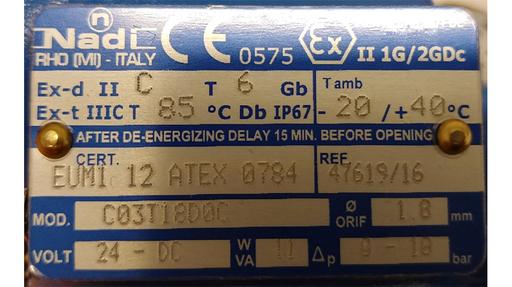
In refineries, chemical plants, offshore platforms, paint shops and grain stores, pneumatic actuators and instruments often sit in areas where flammable gases, vapours or dusts may be present. The filter regulators that supply them are part of that installation, and they must be just as suitable for the hazardous area as the actuators they serve.
Standard air preparation equipment is not designed for this. This guide explains why, how hazardous area zones determine the equipment you need, what makes a filter regulator ATEX-rated, and how to read the marking. For the basics of how filter regulators work, see our guide to filter regulators.
Why Standard Filter Regulators Are Not Suitable
A filter regulator has no electrical parts, so it is easy to assume it poses no ignition risk. That assumption is wrong. Non-electrical equipment can ignite an explosive atmosphere through:
• Static electricity - Fast-moving air and particles inside a plastic bowl can build up an electrostatic charge. A discharge from an unearthed plastic surface can ignite gas or dust.
• Mechanical sparks - Impact or friction between certain metals, particularly aluminium against rusty steel, can produce incendive sparks.
• Hot surfaces - Equipment surfaces must stay below the ignition temperature of the surrounding atmosphere.
• Material failure - Plastic bowls can be attacked by solvents and chemical vapours commonly present in hazardous areas, leading to sudden bowl failure.
For this reason, non-electrical equipment installed in a hazardous area in the UK and EU must be assessed and certified under the ATEX Equipment Directive (2014/34/EU) or the UK equivalent. Site operators have a separate duty under DSEAR in the UK to classify their hazardous areas and select suitable equipment. Our ATEX resource gives an overview of the regulations.
Zones and Equipment Categories
Hazardous areas are classified into zones according to how often an explosive atmosphere is likely to be present. The zone determines the minimum equipment category that can be installed there.
| Zone (gas / dust) | Explosive atmosphere present | Minimum equipment category | Marking |
|---|---|---|---|
| Zone 0 / Zone 20 | Continuously or for long periods | Category 1 | II 1G / II 1D |
| Zone 1 / Zone 21 | Likely in normal operation | Category 2 | II 2G / II 2D |
| Zone 2 / Zone 22 | Not likely in normal operation, and only briefly if it occurs | Category 3 | II 3G / II 3D |
Higher categories can always be used in lower-risk zones: a Category 2 filter regulator is suitable for both Zone 1 and Zone 2. Most pneumatic air preparation is installed in Zone 1 or Zone 2, so Category 2 equipment covers the majority of applications. Filter regulators are rarely suitable for Zone 0.
What Makes a Filter Regulator ATEX-Rated?
An ATEX-rated filter regulator is designed and assessed to remove each of the ignition sources above:
• Anti-static construction - Metal bodies and bowls, or plastics with conductive properties, prevent charge build-up.
• Earthing provision - A means of bonding the unit to earth, so any charge is safely dissipated.
• Non-sparking materials - Material choices that avoid incendive mechanical sparks, such as stainless steel, or aluminium alloys with limited magnesium and titanium content.
• Temperature classification - Assessment of maximum surface temperature under all operating conditions.
• Ex marking and documentation - Permanent marking showing the equipment group, category and protection, with instructions setting out any conditions for safe use.
Decoding the Marking
A typical marking on an ATEX filter regulator reads Ex II 2GD c IIC T6 X:
| Marking | Meaning |
|---|---|
| Ex (in hexagon) | Equipment certified for explosive atmospheres |
| II | Equipment group II: surface industries (group I is mining) |
| 2 | Equipment category 2: suitable for Zone 1 and Zone 2 |
| G / D | Suitable for gas (G) and dust (D) atmospheres |
| c | Type of protection: constructional safety for non-electrical equipment |
| IIC | Gas group IIC: the most onerous group, including hydrogen and acetylene, so also suitable for IIA and IIB |
| T6 | Temperature class: maximum surface temperature 85°C |
| X | Special conditions for safe use apply; check the instructions |
Equipment certified to the newer EN ISO 80079-36 and -37 standards shows Ex h in place of "c", but the meaning for the user is the same. Always check that the gas group and temperature class cover the substances present on site, not only the category.
Polycarbonate vs Metal Bowls in Hazardous Areas
Polycarbonate bowls are common on general industrial filter regulators because they are cheap and transparent. In hazardous areas they raise two problems. First, polycarbonate is an insulator that can hold an electrostatic charge. Second, it is attacked by many solvents, including some found in paint shops, chemical plants and refineries, as well as by certain compressor oils, and can crack or fail suddenly under pressure.
Some plastic-bowled filter regulators carry ATEX certification for limited zones and gas groups, usually with conditions on cleaning and installation. In practice, metal bowls are the safer and more common choice:
• Use metal bowls wherever solvents or aggressive vapours may be present, in Zone 1 and in dust zones, and wherever the conditions of a plastic bowl's certificate cannot be guaranteed.
• Choose 316 stainless steel for offshore, coastal, chemical and sour gas environments where corrosion resistance is also critical.
• Choose copper-free aluminium for less corrosive environments where a lighter, lower cost metal is sufficient. Copper-free alloys resist corrosion better than standard aluminium, and epoxy coating adds further protection.
Metal bowls can be fitted with sight glasses so condensate levels remain visible.
Beyond ATEX: Other Certifications
- UKEX - Since Brexit, Great Britain has its own conformity marking for hazardous area equipment, UKEX, under the UK Equipment and Protective Systems Intended for use in Potentially Explosive Atmospheres Regulations 2016. ATEX-certified, CE-marked equipment is currently still accepted in Great Britain, but check the latest government guidance when specifying for new projects.
- IECEx - The international certification scheme, widely required on offshore and export projects outside Europe.
- GOST / EAC Ex - Required for hazardous area equipment supplied into Eurasian Economic Union markets. Relevant where equipment, skids or packages built in the UK are destined for those regions.
- SIL - Where air preparation forms part of a safety instrumented system, for example supplying an emergency shutdown valve actuator, the filter regulator's reliability contributes to the safety function. Equipment certified to IEC 61508 has documented failure data that allows it to be included in SIL calculations. A failed filter regulator can prevent a shutdown valve from operating, so this is not a minor consideration.
The Sitecna ATEX Air Preparation Range
Measure Monitor Control supplies Sitecna air preparation equipment, manufactured in Italy specifically for harsh and hazardous environments. ATEX certification is standard across the range, not an option.
The Sitecna FR filter regulators are built in 316L stainless steel or epoxy-coated copper-free aluminium, with metal bowls throughout, in sizes from 1/4" to 1". Typical units are marked II 2GD c IIC T6 X, making them suitable for Zone 1, 2, 21 and 22 installations in all gas groups. Features include:
• 5, 25 or 40 µm stainless steel filter elements
• Relieving regulation with outlet ranges such as 0.4–8 bar
• Manual or automatic drains, with inlet pressures up to 30 bar on manual drain versions
• GOST / EAC Ex certification as standard
• TÜV Rheinland certification to IEC 61508 SIL 3 for safety instrumented systems
• Low temperature versions for ambient temperatures down to -55°C, suited to cold climate and offshore installations
• Stainless steel versions suitable for sweet and sour gas service
The wider Sitecna air preparation range includes pressure regulators, filters up to 2", volume boosters, lock-up valves and quick exhaust valves, so a complete hazardous area actuator supply can be built from a single certified family.
In Summary
Filter regulators have no electrical parts, but they can still ignite an explosive atmosphere through static, sparks, hot surfaces or bowl failure. In a hazardous area, select equipment whose ATEX category matches the zone (Category 2 for Zone 1, Category 3 or higher for Zone 2), and check the gas group and temperature class against the substances on site. Choose metal bowls wherever solvents are present or certification conditions for plastic cannot be met, and consider UKEX, IECEx, EAC Ex and SIL requirements for the project.
Browse our range of ATEX pneumatic filter regulators, or speak to our team about hazardous area air preparation for your installation.