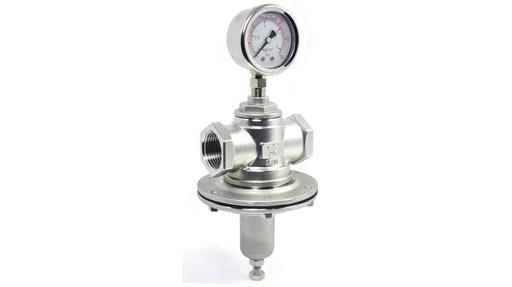
Most pressure regulation is about protecting what lies downstream. Back pressure regulation is the opposite: it controls the pressure upstream of the valve, holding a process, vessel or pump at a stable minimum pressure regardless of what happens further down the line.
It is also an area where terminology causes real confusion. Engineers ask whether they need a back pressure regulator or a pressure sustaining valve, and whether either is the same as a relief valve. This guide explains what back pressure regulation means, how the terms relate, where back pressure devices are used in process systems, and how to select one.
What Back Pressure Regulation Means
A back pressure regulator senses pressure at its inlet. It remains closed while inlet pressure is below the set point, and opens progressively as inlet pressure rises above it, releasing just enough flow downstream to hold the inlet at the set pressure.
The effect is to put a floor under the pressure in everything upstream of the valve. Whether downstream conditions change because a tank empties, demand surges or a line opens to atmosphere, the upstream process continues to see a stable pressure.
Compare this with a pressure reducing valve, which senses its outlet and holds a ceiling on downstream pressure. The two are mirror images, and our article on pressure sustaining vs pressure reducing valves explains the distinction in detail.
Back Pressure Regulator or Pressure Sustaining Valve?
Functionally, a back pressure regulator and a pressure sustaining valve do the same job: both hold a minimum pressure upstream. The difference is largely one of terminology, which tends to follow the industry and the fluid.
• Pressure sustaining valve is the usual term in water, wastewater, irrigation and pumping systems, typically for larger pilot-operated valves on liquid lines. See our guide to what a pressure sustaining valve is and how it works.
• Back pressure regulator is more common in process, chemical, oil and gas, laboratory and analytical applications, often for smaller, more precise valves on both gases and liquids.
• Back pressure valve is used loosely for either, and also for simpler devices on dosing pumps.
In practice, an engineer specifying for a chemical plant and one specifying for a water treatment works may be describing the same device. What matters is not the name but the function: if you need to hold a minimum pressure upstream of the valve, you need a back pressure device.
Key Applications in Process Systems
- Holding pressure in a vessel or reactor - A back pressure regulator on the outlet of a reactor, separator or pressure vessel holds it at the pressure the process needs, venting or passing excess gas or liquid downstream. Maintaining pressure keeps dissolved gases in solution, holds reaction conditions stable, and prevents hot liquids from flashing to vapour.
- Pump discharge protection - On a centrifugal pump discharge, a back pressure device keeps the pump on its curve and prevents run-out; in a recirculation line, it guarantees minimum flow. Our article on pump protection with pressure sustaining valves covers both arrangements.
- Dosing and metering pumps - Where a dosing pump discharges into a line at low or negative pressure, the fluid can siphon through the pump and overdose. A back pressure valve on the discharge provides a constant pressure for the pump to work against, preventing siphoning and improving dosing accuracy.
- Parallel process lines - Where several lines or consumers are fed from a common header, back pressure regulators ensure that priority branches keep their pressure when another branch draws heavily.
- Stable reference for instruments and analysers - Sampling systems, analysers and pressure-sensitive instruments perform best with a steady upstream pressure. A back pressure regulator on the sample return or vent holds the measuring point at a constant pressure, removing a source of measurement error.
- Tank blanketing and low pressure gas control - Very low pressure back pressure regulators vent excess blanketing gas from storage tanks while holding a slight positive pressure above the liquid.
Back Pressure Regulators vs Relief Valves
A back pressure regulator and a pressure relief valve both open when upstream pressure rises, so they are easily confused. The difference is in purpose and duty.
A relief valve is a protective device. It stays closed in normal operation and opens only when pressure exceeds a safe limit, venting enough flow to protect equipment. Where a relief valve is the certified safety device for a vessel, it must be sized and certified for that duty, and a back pressure regulator cannot be substituted for it.
Many systems use both: a back pressure regulator for process control, and a separate relief valve set higher as the last line of protection.
Selecting a Back Pressure Regulator
- Set pressure range - Choose a range that places the required set point in the middle of the span. Very low set pressures, such as tank blanketing, need a valve with a large diaphragm area for sensitivity.
- Flow capacity (Kv/Cv) - Size on the maximum flow the valve must pass while holding the set pressure, using the pressure drop between the set pressure and the downstream pressure. An oversized valve operates close to its seat and becomes unstable. For liquids, Kv = Q × √(SG ÷ ΔP); gases need gas sizing methods.
- Body material and media compatibility - Match body and seals to the fluid and temperature: stainless steel for corrosive, hygienic or high purity duties; iron or bronze for water; PTFE seals for steam or aggressive chemicals.
- Direct-acting or pilot-operated - Direct-acting valves are compact, fast and simple, and suit smaller lines, gases and low pressures. Pilot-operated valves hold the set point more accurately across a wide flow range and suit larger liquid lines.
- Pressure rating and connections - Confirm the body rating exceeds the highest possible system pressure, and choose BSP or flanged connections to suit the pipework.
Z-Tide Valves for Back Pressure Applications
The Z-Tide range supplied by Measure Monitor Control covers back pressure duties from micro pressures to 10 bar.
| Model | Type | Set pressure range | Media | Typical back pressure application |
|---|---|---|---|---|
| P09 | Direct acting, balanced piston, 316 stainless | 1–5 bar, 4–10 bar | Liquids, gases; steam to 180°C with PTFE seals | Vessel and reactor pressure, dosing pumps, process lines |
| P26 | Direct acting, large diaphragm, 316 stainless | 0.2–1.5 bar | Liquids, gases | Low pressure process control, instrument and analyser reference |
| P43 | Direct acting, large diaphragm, 316 stainless | 0.02–0.2 bar | Liquids, gases | Tank blanketing, micro pressure control |
| P04 | Pilot operated, piston; iron, bronze or stainless | 0.3–4 bar, 2–8 bar | Liquids | Pump discharge, large liquid lines DN50–DN300 |
In Summary
Back pressure regulation holds a minimum pressure upstream of the valve. "Back pressure regulator" and "pressure sustaining valve" describe the same function; the term used depends mainly on the industry. In process systems, back pressure devices hold vessels and reactors at pressure, protect pumps, stop dosing pumps siphoning, prioritise process lines, give instruments a stable reference and control tank blanketing. They are control devices, not substitutes for a certified relief valve. Select on set pressure range, Kv, materials and design, with direct-acting valves for smaller and low pressure duties and pilot-operated valves for larger liquid lines.
Browse our range of pressure sustaining and back pressure valves and our wider pressure regulation range, or speak to our engineers about back pressure regulation for your process.