Flow measurement is fundamental to process control, energy management, and utility billing across industrial operations. Whether the goal is monitoring compressed air consumption, measuring steam flow through a distribution system, verifying liquid transfer quantities, or detecting waste through leak identification, the right flow meter technology makes the difference between reliable data and numbers that cannot be trusted.
Selecting the wrong technology for the duty is a common and costly error. A meter specified without reference to the fluid phase, the flow range, the required output, or the installation conditions may produce readings that drift, fail intermittently, or are simply wrong, without providing any visible indication that something is amiss. Understanding the operating principles behind each technology is the starting point for getting the specification right.
This guide covers the four flow measurement technologies offered by Measure Monitor Control, the duties each is suited to, what distinguishes them technically, and the key parameters to establish when specifying.
Fundamental Concepts in Flow Measurement
Before comparing technologies, it is worth establishing the distinction between the two principal ways of expressing flow.
Volumetric flow rate expresses the volume of fluid passing a point per unit time, typically in litres per minute, cubic metres per hour, or cubic feet per minute. This is straightforward for liquids, which are essentially incompressible. For gases, it is less useful because the volume of a gas changes with both pressure and temperature. One cubic metre of compressed air at 7 bar contains considerably more air than one cubic metre at 1 bar.
Mass flow rate expresses the mass of fluid passing per unit time, typically in kilograms per hour or grams per minute. For gases, mass flow is the more meaningful quantity because it is independent of the operating pressure and temperature. If you need to know how much gas is being consumed, how much is available for a process, or how efficiently a compressor is performing, mass flow is the correct unit to measure.
This distinction is not just theoretical. It determines which meter types are appropriate, how outputs should be interpreted, and whether corrections for pressure and temperature need to be applied downstream of the meter.
The ISO 5167 standard series covers measurement of fluid flow by differential pressure devices in circular cross-section conduits and is a key reference for flow measurement practice.
Thermal Mass Flow Meters for Dry Gases
Operating principle
Thermal mass flow meters use a calorimetric measurement principle. Two temperature sensors are embedded in or adjacent to the flow stream, with one acting as a heated reference element. Gas flowing past the sensors carries heat away from the heated element. The rate at which heat is dissipated is proportional to the mass flow rate of the gas: higher mass flow removes more heat, lower mass flow removes less.
This is a direct measurement of mass flow. No correction for line pressure or gas temperature is required, which eliminates a significant source of error compared to volumetric meters that need compensating measurements to calculate mass flow.
What thermal mass meters are suited to
Thermal mass flow meters are designed for dry gases. They are well suited to compressed air, nitrogen, carbon dioxide, oxygen, argon, helium, hydrogen, and methane. The key constraint is that the gas must be dry: condensate or liquid droplets on the sensor elements cause erroneous readings and can damage the sensors. For compressed air measurement, the air should be downstream of any dryer, and filtration is recommended upstream of the sensor.
Their ability to measure very low flow rates makes them well suited to leak detection in compressed air systems, where the flow associated with a significant leak may be small relative to the system's normal demand. Measurement of bidirectional flow is supported by certain models, covering applications where flow direction reverses.
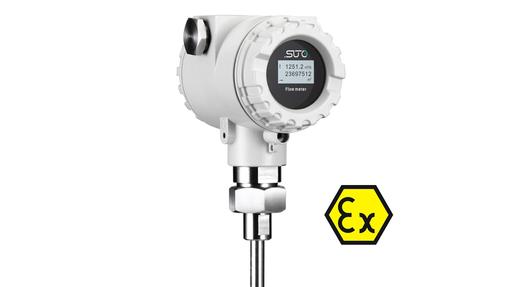
The S415 and S418 inline thermal mass sensors cover pipe sizes DN8 to DN25, with the S418 offering higher accuracy, a wider gas compatibility range, and an integral datalogger. For larger pipe sizes and insertion-style measurement, the S401 insertion sensor and S421 inline sensor extend coverage to larger bore pipework, including output options for instantaneous flow rate, totalised consumption, and gas temperature. For vacuum conditions, the S418-V vacuum flow sensor is designed specifically for sub-atmospheric pressure operation.
Advantages and limitations
Thermal mass meters measure mass flow directly, require no moving parts, and can detect very low flow rates. They are well suited to high turndown applications where the flow range varies over a wide ratio. The main limitation is that they are calibrated for specific gases: a meter calibrated for compressed air will not give accurate results if the gas changes. Moisture and particulates require management upstream.
Pitot Tube Flow Meters for Wet Air, Gas and Steam
Operating principle
A pitot tube measures flow velocity by sensing the difference in pressure between the stagnation pressure at the impact hole (facing into the flow) and the static pressure at the reference port. This differential pressure is proportional to the square of the flow velocity, as described by Bernoulli's principle. Averaging pitot tubes, which use multiple sensing points across the pipe cross-section, provide a measurement that better represents the average velocity across the full flow profile.
The pitot tube produces a differential pressure output. To convert this to a flow rate, the cross-sectional area of the pipe and the density of the fluid must be known. For gases and steam, where density varies with pressure and temperature, a separate measurement of both conditions is typically required to calculate accurate mass or volumetric flow.
What pitot tube meters are suited to
Pitot tubes are particularly well suited to applications where insertion into the pipe is more practical than an in-line meter body, such as large diameter ducts and pipes. They are also well suited to steam and wet gas measurement, where condensate management in the impulse lines needs to be addressed in the installation design but where the underlying measurement principle is robust to the fluid characteristics.
The S430 pitot tube flow sensor from Measure Monitor Control is suited to wet air, gas, and steam applications. It is insertable, allowing installation without taking the line out of service in many cases, and covers a wide range of pipe sizes.
Advantages and limitations
Pitot tubes are mechanically simple, have no moving parts, and offer a relatively low-cost solution for large bore applications. Accuracy diminishes at low flow velocities because the differential pressure output is proportional to velocity squared, so turndown is more limited than thermal mass meters. Accurate flow measurement requires a stable, well-developed flow profile upstream of the sensor, typically a straight pipe run of at least 10 to 20 diameters upstream, free from bends, valves, and other flow disturbances.
Variable Area Flow Meters (Rotameters) for Gases
Operating principle
A variable area flow meter consists of a vertically oriented tapered tube containing a float. Gas flowing upward through the tube lifts the float until the annular area between the float and the tube wall is large enough for the drag force on the float to balance gravity. The equilibrium position of the float indicates the flow rate on the graduated scale. The measurement principle is entirely passive: no power supply, no electronics, and no signal output in the basic form.
What variable area meters are suited to
Variable area flow meters are well suited to gases in process control, laboratory, and instrumentation duties where a simple, direct visual indication of flow is sufficient and where continuous electrical output is not required. They are common on gas supply manifolds, purge systems, and sampling lines. The lack of any power requirement is an advantage in certain hazardous area installations, where the introduction of electrical equipment requires additional certification and installation care.
Advantages and limitations
Variable area meters are low-cost, reliable, and easy to read. Their main limitations are that they must be installed vertically, that they give a visual-only output in the basic form (signal output transmitters are available as options), and that the float scale is calibrated for a specific gas at specific reference conditions. If operating conditions differ significantly from calibration conditions, a correction factor must be applied. Turndown is moderate, typically in the range of 10:1.
Clamp-On Ultrasonic Flow Meters for Liquids
Operating principle
Clamp-on ultrasonic flow meters measure the transit time of ultrasonic pulses transmitted through the pipe wall and the liquid. Two transducers are clamped to the outside of the pipe, angled relative to each other. One transmits a pulse that travels diagonally across the flow to the receiver; the pulse is then transmitted in the opposite direction. Because flow velocity adds to the speed of propagation in one direction and subtracts from it in the other, the difference in transit time between the two directions is proportional to the flow velocity. Integrating the velocity against the known pipe cross-sectional area gives the volumetric flow rate.
The transducers do not contact the liquid at any point. They clamp to the outside of the existing pipe and transmit ultrasonically through the pipe wall.
What clamp-on ultrasonic meters are suited to
Clamp-on ultrasonic flow meters are suited to liquids in full pipes. Water, including potable water, process water, cooling water, and chilled water, is the most common application. They are also used on hydraulic oil, diesel, and many other liquids. The non-invasive installation is a particular advantage for systems where cutting the pipe or taking the system offline is impractical, where the liquid must not be contaminated by the meter body, or where the liquid is highly corrosive and an in-line meter body would degrade.
Because no pipe cutting is required, clamp-on meters can be deployed rapidly for both permanent monitoring and temporary flow surveys without disruption to the process.
Advantages and limitations
The non-invasive installation is the defining advantage: no process interruption, no risk of contamination, no in-line pressure drop, and suitability for pipes of almost any material. The main requirements are that the liquid must fill the pipe fully and be relatively clean and free from high concentrations of entrained gas bubbles or particulates, which scatter the ultrasonic signal and degrade accuracy. The pipe material, wall thickness, and outer diameter must all be known to configure the meter correctly. Adequate straight pipe runs upstream and downstream of the transducer position are required, as with all velocity-sensing flow meters.
Key Selection Criteria
The choice of flow meter technology depends on working through the following parameters systematically.
- Fluid phase - Liquid, gas, or steam each point toward different technologies. Thermal mass meters are for dry gases only. Clamp-on ultrasonics are for liquids in full pipes. Pitot tubes cover gases, steam, and wet air. Variable area meters cover gases.
- Mass flow or volumetric flow - If mass flow is the required output, thermal mass meters provide this directly. Other technologies measure volumetric flow, which requires pressure and temperature compensation to derive mass flow for gases.
- Flow range and turndown - Thermal mass meters offer the widest turndown and are well suited to applications where flow varies by a large ratio. Pitot tube meters have more limited turndown at low velocities. The minimum flow to be detected must be above the meter's stated lower range limit.
- Pipe size and installation - Inline meters require the pipe to be cut and the meter installed in the flow path. Clamp-on and insertion meters can be installed on existing pipework without process interruption. Available straight pipe runs upstream and downstream must be checked against the manufacturer's minimum requirements.
- Wet or dry gas - Thermal mass meters require dry gas upstream. Pitot tube meters are suitable for wet gas and steam where thermal mass meters would be at risk.
- Output requirements - Does the meter need an electrical output for connection to a data logger, SCADA, or controller? Basic rotameters give visual indication only. Thermal mass, pitot tube, and ultrasonic meters typically provide 4-20mA analogue or digital outputs as standard or as options.
For further guidance on compressed air and gas flow measurement, see our resource on flow measurement of compressed air and gases.
Browse our full range of flow meters and sensors, or contact our team to discuss the flow measurement requirements for your application.