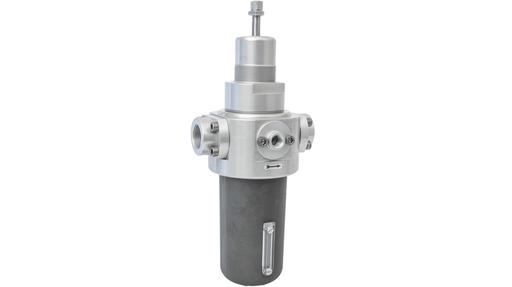
Almost every pneumatic actuator, positioner and instrument needs two things from its air supply: it must be clean, and it must be at the right pressure. The filter regulator delivers both in a single compact unit, which is why it is one of the most widely used components in pneumatic air preparation.
This guide explains what a filter regulator is, how it works, the filtration grades and options available, and when a combined unit is the right choice compared with a separate filter and regulator.
What Is a Filter Regulator?
A filter regulator combines an air filter and a pressure regulator in one body. The filter section removes liquid water, oil droplets and solid particles from the compressed air, and the regulator section reduces the supply pressure to a stable, adjustable outlet pressure for the equipment it serves.
Filter regulators are typically installed at the point of use, immediately upstream of the equipment they protect, rather than at the compressor. Even where air is dried and filtered centrally, distribution pipework introduces rust, scale and condensate, and line pressure is usually higher and less stable than individual devices require. A filter regulator at each point of use deals with both.
How a Filter Regulator Works
Air passes through the unit in four stages:
1. Centrifugal separation - Air enters the bowl through a set of angled deflector vanes that spin it into a vortex. Heavier liquid droplets and larger particles are thrown outwards against the bowl wall and fall to the bottom, away from the airflow. A baffle below the element creates a quiet zone so collected liquid is not picked up again.
2. Filtration - The air then passes through the filter element, usually sintered metal or plastic, which traps the remaining solid particles down to the element's rated size.
3. Condensate collection and draining - Separated water and oil collect in the base of the bowl and are removed through a manual or automatic drain.
4. Pressure regulation - Clean air flows to the regulator section, where a spring-loaded diaphragm balances outlet pressure against the adjustable spring setting and modulates a valve to hold the set pressure as demand changes.
Most filter regulators are of the relieving type: if downstream pressure rises above the set point, for example when the setting is turned down, the excess vents through a small port in the diaphragm. This allows the outlet pressure to be reduced without exhausting the downstream line. Non-relieving types are used where the media should not be vented, such as with some process gases.
Filter Regulator or Separate Filter and Regulator?
Combining the two functions brings clear advantages:
• Space saving - One body instead of two, which matters on crowded actuator and valve panels.
• Lower installation cost - Fewer connections, fittings and mounting brackets, and fewer potential leak paths.
• Single maintenance point - One unit to inspect, drain and service.
A filter regulator is the right choice for most point-of-use applications: supplying valve actuators and positioners, instrument air at individual devices, and general factory air for tools and machines.
Separate units make more sense when the filtration duty is heavier than a combined unit can handle, for example where a high-efficiency coalescing filter is needed upstream of a regulator to remove oil aerosol, or where several regulators at different pressures are fed from one filter. They are also preferred where the filter needs servicing far more often than the regulator, or where very high flows exceed the capacity of combined units.
Filtration Grades
The filter element's rating, in microns (µm), sets the size of particle it will reliably remove. Finer is not automatically better: a finer element blocks more quickly and creates more pressure drop, so match the grade to what the downstream equipment needs.
| Element grade | Removes | Typical application |
|---|---|---|
| 40 µm | Coarse particles, scale, bulk liquid | General air supply, rugged equipment, heavily contaminated lines |
| 25 µm | Larger particles and liquid water | Air tools, cylinders, general factory air |
| 5 µm | Fine particles | Valve actuators, positioners, instrument air (the most common standard grade) |
| 3 µm | Very fine particles | Sensitive instruments and precision pneumatics |
| Coalescing | Oil and water aerosols as well as particles | Air for instruments, analysers or processes sensitive to oil carry-over |
Note that particulate elements do not remove oil aerosol or water vapour. If oil carry-over is a concern, specify a coalescing element; if dew point is a concern, the air must be dried upstream.
Bowl Materials
Polycarbonate bowls are transparent, lightweight and inexpensive, and let the operator see collected condensate at a glance. They are suitable for many general industrial applications, but polycarbonate can be attacked by certain solvents, compressor oils and chemical vapours, and loses strength at higher temperatures. Polycarbonate bowls are normally fitted with a metal guard.
Metal bowls, in aluminium or stainless steel, are used where the atmosphere contains solvents or chemicals, where temperatures or pressures are higher, and in hazardous areas, where a plastic bowl may present an electrostatic ignition risk. Metal bowls can be fitted with a sight glass to show condensate level. In offshore, petrochemical and other harsh environments, 316 stainless steel is the standard choice for corrosion resistance. The requirements for hazardous areas are covered in our guide to ATEX-rated air preparation.
Drain Types
• Manual drain: a screw or push valve opened periodically by an operator. Simple and reliable, but relies on routine maintenance; a neglected manual drain lets condensate rise into the airflow.
• Semi-automatic drain: opens when the line is depressurised, so the bowl empties each time the supply is shut off. Suits equipment that is regularly isolated.
• Fully automatic drain: a float-operated valve that discharges condensate whenever it reaches a set level, with no operator input. The best choice for continuously pressurised lines, high-moisture air and remote or unattended locations.
The Sitecna FR Filter Regulator Range
Measure Monitor Control supplies the Sitecna FR filter regulator range, manufactured in Italy and designed for harsh and hazardous conditions such as valve actuation systems, oil and gas, and process automation.
• Construction: 316L stainless steel or copper-free aluminium bodies and bowls; no plastic bowls, making the range suitable for solvent atmospheres and hazardous areas.
• Sizes: FR04 (1/4"), FR06 (3/8"), FR08 (1/2"), FR12 (3/4") and FR16 (1").
• Filtration: 316 stainless steel elements in 5, 25 or 40 µm as standard, with further options for some models.
• Regulation: relieving type, with typical outlet ranges such as 0.4–8 bar and 0.4–10 bar depending on model.
• Drains: manual or automatic.
• Certification: ATEX and GOST Ex as standard, and certified by TÜV Rheinland to IEC 61508 SIL 3 for use in safety instrumented systems.
• Media: compressed air and inert gases, with stainless steel versions also suited to sweet and sour gas service.
Low temperature versions are also available for cold climate installations.
In Summary
A filter regulator cleans and regulates compressed air in one compact unit, using centrifugal separation and a filter element to remove water and particles before a diaphragm regulator sets the outlet pressure. It is the natural choice for point-of-use air preparation at actuators, instruments and machines. Choose the filtration grade to suit the equipment, a metal bowl for chemical or hazardous environments, and an automatic drain for continuously pressurised or unattended lines. Where heavy oil removal or multiple regulated pressures are needed, consider separate units instead.
Browse our range of pneumatic filter regulators and wider air preparation products, or request a filter regulator specification from our team.