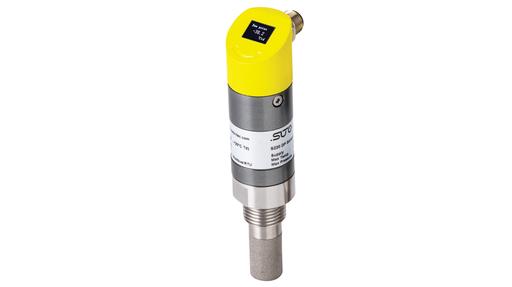
Dew point is the most useful single indicator of how well a compressed air drying system is performing. Yet measurement ranges, sensing technologies, outputs and calibration requirements vary widely between instruments, and the wrong choice can mean readings that drift, a sensor that cannot resolve the dew point you need to verify, or one that cannot talk to your control system.
This guide sets out a practical methodology for selecting a dew point sensor for compressed air, covering sensor technologies, installation methods, key specification parameters and calibration for ISO 8573 compliance, using the SUTO iTEC range as worked examples.
Start With the Right Dew Point Basis
In a compressed air system, dew point depends on both moisture content and pressure. Pressure dew point (PDP) is the dew point at line pressure: it determines whether condensation forms in your pipework, and it is the basis of the ISO 8573-1 water classes. Atmospheric dew point (ADP) is the dew point of the same air once expanded to atmospheric pressure, and is always lower. At 7 bar(g), a +3°C PDP corresponds to roughly -20°C ADP.
Confusing the two is a common specification error. For compressed air, choose a sensor that measures at line pressure and reports PDP, or one with an integral pressure input. Our guide to pressure dew point vs atmospheric dew point explains the conversion in detail.
Understanding Dew Point Sensor Technologies
The sensing technology determines accuracy, how low a sensor can measure, response speed and long-term drift.
Capacitive polymer sensors use a hygroscopic polymer film whose capacitance changes as it absorbs water vapour. They are robust, compact, cost-effective and tolerate occasional liquid water well. Performing best from around -60°C to +20°C PDP, they suit refrigerant dryers and most desiccant dryer applications.
Aluminium oxide sensors measure the change in impedance of a porous oxide layer. They reach very low dew points, often -80°C or below, but are more prone to drift and contamination, can be damaged by liquid water, and need more frequent calibration.
Chilled mirror hygrometers cool a mirror until condensation forms and read its temperature directly. As a fundamental measurement, this is the laboratory reference method, but cost, size and sensitivity to oil contamination usually restrict it to calibration and reference duties.
Quartz crystal microbalance (QCM) sensors detect moisture through changes in a coated crystal's oscillating frequency. Sensitive into the parts-per-billion range, they respond quickly and stay accurate at ultra-low dew points. The SUTO S220 uses QCM to measure down to -100°C.
| Technology | Typical PDP range | Drift | Best suited to |
|---|---|---|---|
| Capacitive polymer | -60°C to +20°C | Low | Refrigerant and most desiccant dryers |
| Aluminium oxide | -80°C or below | Moderate to high | Low dew point process gas |
| Chilled mirror | Model-dependent | Very low | Calibration and reference |
| QCM |
-100°C to 0°C | Low | Ultra-dry air, Class 1 verification |
Inline vs Extractive Measurement
Inline measurement places the sensor directly in the line, typically through a G1/2" connection or a measuring chamber. It sees full line pressure, so it reports true PDP, and is the natural choice for continuous monitoring downstream of a dryer.
Extractive measurement draws a small sample flow to the sensor, which suits hot, large or inaccessible lines and portable meters. Sample lines should be short and stainless steel or PTFE, as some plastics absorb moisture, and leaking fittings can draw in ambient moisture. If the sample is expanded before the sensor, the reading is ADP and must be converted.
Many sites use both: a fixed inline transmitter at the dryer outlet, and a portable meter to spot-check points of use.
Key Specification Parameters
Measurement range: Match the range to your dryer and target ISO 8573-1 water class, keeping the target dew point well inside the span rather than at its edge:
Refrigerant dryers (+3°C PDP, Class 4): -20°C to +50°C
Desiccant dryers (-40°C PDP, Class 2): -50°C or -60°C to +20°C
Ultra-dry systems (-70°C PDP, Class 1): down to -100°C
Pressure rating: Most compressed air sensors are rated to around 16 bar. High-pressure systems such as PET blow moulding need a sensor or measuring chamber rated accordingly.
Output signal: 4–20mA suits almost any PLC or BMS, with dual outputs available for dew point plus temperature or pressure. RS485 Modbus carries multiple variables and diagnostics over one bus, while relay outputs provide simple high dew point alarms.
Environmental rating: IP65 is typical for compressor houses. Sensors in classified hazardous areas need ATEX certification for the zone; see our ATEX and hazardous area resource.
Calibration, Drift and ISO 8573 Compliance
Every dew point sensor drifts. Oil aerosol, particles, liquid water and temperature cycling gradually alter the sensing element, and because drift is silent, the instrument keeps showing a plausible figure while the real dew point moves out of specification.
If dew point readings are used as evidence that compressed air meets its ISO 8573-1 class, they are only credible when the sensor is in calibration and traceable to a recognised standard. Plan for annual calibration with traceable certificates, choose sensors that can be swapped quickly, and protect the element with correct upstream filtration. Periodically checking a fixed transmitter against a recently calibrated portable meter gives early warning of drift.
Dew Point Sensor Selection Guide by Application
The table below brings these factors together for the most common compressed air applications. It is intended as a starting point; the specific conditions at your installation may change the recommendation.
| Application | Target PDP (ISO 8573-1 class) | Recommended range | Technology | Installation | SUTO instrument |
|---|---|---|---|---|---|
| Refrigerant dryer outlet, general factory air | +3°C (Class 4) | -20°C to +50°C | Capacitive polymer | Inline, fixed | S215 |
| Desiccant dryer outlet | -40°C (Class 2) | -60°C to +20°C | Capacitive polymer | Inline, fixed | S211 |
| Ultra-dry air, electronics, pharmaceutical | -70°C (Class 1) | -100°C to 0°C | QCM | Inline, fixed | S220 |
| Hazardous area installation | Application-dependent | To -100°C | Application-dependent | Inline, fixed, ATEX | S230 / S231 |
| Standalone dryer monitoring with local display and alarm | Application-dependent | Application-dependent | Capacitive polymer | Inline, fixed | S305 |
| Spot-checks, audits, verifying fixed sensors | Any | Wide | Capacitive polymer | Portable, extractive or inline | S520 |
Applying the Methodology: The SUTO iTEC Range
As UK agent for SUTO iTEC, Measure Monitor Control supplies instruments for every application above.
The S215 is designed for refrigerant dryers, while the S211 measures to -60°C with Modbus communication for desiccant dryers. The S220 measures from -100°C to 0°C at up to 16 bar, mounts through a G1/2" thread, is rated IP65, and offers 4–20mA, dual 4–20mA and Modbus outputs, with an optional integral pressure sensor. For hazardous areas, the S230 and S231 measure to -100°C with ATEX certification, and the S305 combines sensor, display and alarm in one unit.
The S520 smart dew point meter is the portable partner to any fixed installation, used for spot-checks across the network, verifying fixed sensors between calibrations and gathering ISO 8573 audit evidence. For complete air quality monitoring, see our compressed air purity range.
Summary: Selecting the Right Dew Point Sensor
Confirm you need pressure dew point and identify your target ISO 8573-1 water class. Choose capacitive polymer for most dryer applications and QCM for ultra-dry air. Use fixed inline transmitters for continuous monitoring and a portable meter for verification. Match range, pressure rating, output and IP or ATEX rating to your installation, and plan for annual traceable calibration.
Browse the full range of SUTO dew point sensors and meters, or contact our team to request a measurement specification review.