Compressed air is one of the most widely used utilities in industrial production, yet its quality is rarely given the attention it deserves. Unlike electricity or gas, compressed air is generated on site, and every compressor introduces contaminants into the system from the moment it draws in ambient air. Left unaddressed, those contaminants travel through distribution pipework to the point of use, where they damage equipment, compromise product quality, and in some sectors create serious safety and regulatory risks.
ISO 8573 is the international standard that defines how compressed air quality is classified and measured. This guide explains the standard in full, covers the contaminants it addresses, the treatment technologies used to achieve compliance, how compliance is verified through measurement, and the regulatory obligations that apply in the UK.
Why Compressed Air is Never Naturally Clean
The starting point for understanding compressed air quality is recognising that ambient air is not clean. A cubic metre of typical industrial air contains millions of particles of dust, rust, pollen, and microorganisms, along with water vapour and hydrocarbon vapours from vehicle and industrial emissions.
Compression makes this significantly worse. When air is compressed to 7 bar, contaminants are concentrated roughly eightfold. The compression process also raises air temperature substantially, and as that air cools through the aftercooler and distribution system, water vapour condenses into liquid water. In oil-lubricated compressors, oil aerosols and vapour are added to the mix. By the time compressed air reaches the point of use without treatment, it bears little resemblance to the ambient air that entered the compressor inlet.
The consequences play out across the system: corrosion in receivers and pipework, premature failure of pneumatic valves and cylinders, product contamination, and process quality failures. In regulated sectors, the consequences extend to regulatory non-compliance and the associated legal and commercial exposure.
What Is ISO 8573?
ISO 8573 is a multi-part international standard published by the International Organization for Standardization (ISO) that establishes a framework for classifying and measuring the purity of compressed air.
ISO 8573-1 defines the purity classes for compressed air. This is the part most commonly referenced when specifying air quality. The current version in use is ISO 8573-1:2010.
ISO 8573-2 through ISO 8573-9 define the test methods for measuring each category of contaminant, covering oil aerosol, dew point, particle concentration, oil vapour, total oil content, microbiological contamination, and gaseous contaminants.
The Three Contaminant Categories
ISO 8573-1 addresses three main categories of contaminant. Each is assigned an independent class rating, and together they form the complete air quality specification.
Solid Particles
Solid particles include atmospheric dust drawn in through the compressor inlet, rust and pipe scale from the distribution system, wear debris from compressor internals, and in some installations degraded filter media. They are classified by particle size and concentration per cubic metre of air. Particles cause abrasive wear in pneumatic actuators and valves, block orifices and instrument sensing lines, and in cleanroom and food-contact applications introduce contamination risk.
Water
Water in compressed air is present in three forms: liquid water, water aerosol, and water vapour. The water class in ISO 8573-1 is defined by Pressure Dew Point (PDP), the temperature at which water vapour in the compressed air will condense to liquid at system operating pressure. The lower the PDP, the drier the air. Water causes corrosion, promotes microbial growth in food and pharmaceutical applications, causes freeze-up in cold environments, and degrades pneumatic equipment performance.
Oil
Oil contamination originates primarily from oil-lubricated compressors, but ambient hydrocarbon vapours can also contribute even in oil-free compressor installations. Oil is classified in three forms: liquid oil, oil aerosol, and oil vapour. The class limit is expressed as total oil content in mg/m³. Oil contamination causes product spoilage in food, beverage, and pharmaceutical production, surface defects in coating applications, and degradation of seals and soft materials in downstream equipment.
Understanding the ISO 8573-1 Purity Classes
Each contaminant category is assigned a class number from 0 to 9. Lower numbers represent cleaner air. The complete specification for a compressed air system is expressed as three numbers in the format [Particle : Water : Oil].
For example, a specification of ISO 8573-1:2010 [2:4:2] means Particle Class 2, Water Class 4, and Oil Class 2.
Purity Class Reference Table
| Class | Solid particles 0.1–0.5 µm per m³ |
Water Pressure dew point |
Total oil mg/m³ |
|---|---|---|---|
| 0 | As specified — better than Class 1 | As specified — better than Class 1 | As specified |
| 1 | ≤ 20,000 | ≤ −70°C | ≤ 0.01 |
| 2 | ≤ 400,000 | ≤ −40°C | ≤ 0.1 |
| 3 | ≤ 4,000,000 | ≤ −20°C | ≤ 1.0 |
| 4 | Not defined at this size | ≤ +3°C | ≤ 5.0 |
| 5 | Not defined at this size | ≤ +7°C | Not classified |
| 6 | Not defined at this size | ≤ +10°C | Not classified |
Simplified reference. Full class limits including all particle size bands are defined in ISO 8573-1:2010, which should be consulted for specification purposes. A complete specification is expressed as three numbers: [Particle : Water : Oil].
Class 0: What It Actually Means
Class 0 is frequently misunderstood. It does not mean zero contamination. It is a user-defined class, more stringent than Class 1, with specific limits agreed between the system operator and equipment supplier. A claim of Class 0 is only meaningful when accompanied by defined, measurable purity limits, making it a contractual commitment rather than a standardised class. In practice, Class 0 specifications are most common in pharmaceutical manufacturing and semiconductor production.
Technologies for Achieving Compressed Air Purity
Reaching a specific ISO 8573-1 class requires a staged treatment system. No single technology removes all contaminant types, and the correct combination depends on the purity class required and the nature of the installation.
Filtration
Compressed air filters remove solid particles and, in the case of coalescing filters, liquid oil and water aerosols. A typical treatment train includes a general purpose pre-filter to capture larger particles, a coalescing filter to remove oil and water aerosols and finer particulates, and for oil-sensitive applications, an activated carbon adsorber to remove oil vapour. Filter elements require regular replacement; a saturated element provides no protection and adds significant pressure drop to the system.
Drying
Refrigerant dryers cool compressed air to condense and drain moisture, achieving a pressure dew point of approximately +3°C. This meets Water Class 4 and is suitable for the majority of general industrial applications.
Desiccant dryers pass air over hygroscopic material to achieve pressure dew points as low as -70°C or below, meeting Water Classes 1, 2, and 3. They operate in twin-tower configurations with one tower drying while the other regenerates. Required wherever freezing temperatures, very low humidity, or sensitive processes demand extremely dry air.
Membrane dryers use selective permeation through hollow fibre membranes to remove moisture. They achieve moderate dew points and are well suited to point-of-use drying where compact, maintenance-free operation is needed.
Oil-Free Compression
For critical applications where even trace oil contamination is unacceptable, an oil-free compressor eliminates the primary source of oil in the system. However, oil-free does not mean contamination-free: ambient hydrocarbons and particles are still drawn in and concentrated by compression, so downstream filtration and drying remain necessary.
Measuring Compressed Air Purity: The Verification Stage
Designing and installing a treatment system is only part of achieving ISO 8573 compliance. Without ongoing measurement, there is no evidence that the system is performing to its specified class. Filters become saturated, drains block, dryers degrade, and purity classes can drift without any visible indication at the point of use.
Oil vapour measurement. Oil vapour is invisible and cannot be detected by observation alone. The S120 oil vapour sensor provides continuous measurement of oil vapour concentration in compressed air, supporting compliance with ISO 8573-5.
Particle concentration measurement. The S130 laser particle counter measures particle concentration and size distribution in compressed air in accordance with ISO 8573-4, verifying that filtration is achieving the specified particle class.
Dew point measurement. Measure Monitor Control supply a range of dew point sensors and instruments for both in-line continuous monitoring and portable spot-checking, verifying that the drying system is achieving the required water class.
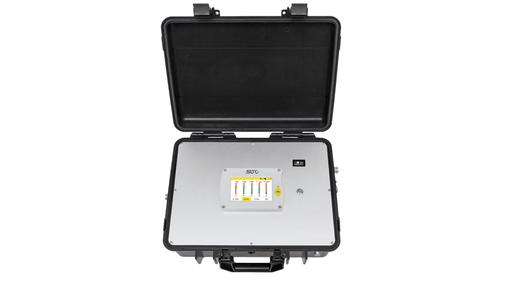
Portable multi-parameter analysis. The S600 portable compressed air purity analyser measures oil vapour, dew point, and particle concentration in a single portable instrument, enabling full ISO 8573-1 compliance verification across multiple sample points.
Continuous fixed installation monitoring. The S601 continuous compressed air analyser provides permanent in-line monitoring of all three contaminant parameters, suitable for processes where sustained compliance must be demonstrated and deviations need to trigger alarms.
Breathing Air: EN 12021
Compressed air used for breathing purposes, in applications including breathing apparatus, airline respirators, and diving equipment, is not covered by ISO 8573. The applicable standard is EN 12021, which sets limits for oxygen, carbon monoxide, carbon dioxide, water, and oil to ensure the air is safe to breathe.
The S605 portable breathing air analyser and S606 continuous breathing air analyser both measure the full suite of EN 12021 parameters including O2, CO, CO2, dew point, and oil or VOC content.
Compliance Obligations and UK Regulations
ISO 8573 compliance is not purely a quality management activity. Several UK legal frameworks create direct obligations on operators of compressed air systems.
Pressure Systems Safety Regulations 2000 (PSSR) require that pressurised systems above certain thresholds are maintained safely and operated under a written scheme of examination. Maintaining air purity is part of ensuring the system remains safe and fit for purpose.
Provision and Use of Work Equipment Regulations 1998 (PUWER) require that work equipment, including compressed air systems, is maintained in an efficient state and good repair. Contaminated air that degrades downstream equipment constitutes a failure of this duty.
Food and beverage production where compressed air contacts product or packaging is subject to food safety legislation and standards including BRC Global Standards and HACCP principles. The Food Standards Agency provides guidance on compressed air as a food contact material.
Pharmaceutical manufacture is governed by MHRA Good Manufacturing Practice (GMP) guidelines. The MHRA Blue Guide is the relevant UK reference, requiring compressed air used in manufacturing and packaging to be of defined quality with documented evidence of compliance.
Testing frequency is risk-based. High-risk applications such as pharmaceutical and food-contact processes typically require quarterly testing by an accredited third party. General industrial applications may require annual testing as a minimum.
Common Causes of Purity Class Failure
- Filter element overrun. Filter elements have finite capacity. Operating beyond the recommended replacement interval allows contaminants to break through.
- Blocked condensate drains. Auto-drains that become blocked allow liquid water and oil to accumulate and eventually carry over into the distribution system.
- Dryer performance degradation. Refrigerant dryers lose efficiency as condenser fouling increases. Desiccant dryers lose capacity as the material becomes contaminated or fails to regenerate fully.
- Pipework contamination. Carbon steel distribution pipework corrodes internally, producing rust particles that recontaminate air even when upstream filtration is correctly maintained.
- Recontamination at the point of use. Flexible hoses, quick-connect couplings, and tool connections that are not regularly inspected can introduce contamination downstream of the treatment system.
Continuous monitoring, as opposed to periodic sampling alone, is the only way to detect these failures promptly rather than when they have already caused process or product problems.
Summary: Key Steps to ISO 8573 Compliance
Specification. The required purity class for each point of use needs to be defined based on process requirements. Different parts of the same system may need different specifications.
Treatment. The treatment system, including filtration, drying, and where necessary oil-free compression, needs to be designed and sized to achieve the specified purity class under all operating conditions.
Measurement. Regular testing and, for critical applications, continuous monitoring are needed to verify that the system is performing to specification. Testing covers all three contaminant categories defined in ISO 8573-1.
Maintenance. Filter elements, desiccant beds, dryer systems, and condensate drains all require scheduled maintenance to sustain treatment system performance over time.
For measurement instruments to verify compressed air purity in line with ISO 8573, browse the compressed air purity measurement range at Measure Monitor Control, or contact the team to discuss the specific monitoring requirements for your installation.