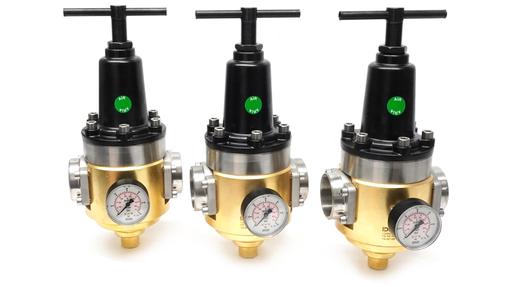
Most pressure regulators are offered in a choice of brass, aluminium or 316 stainless steel, often in the same size and pressure range. The three can look interchangeable on a datasheet, but they are not. The body material determines which gases and liquids the regulator can safely handle, how high a pressure it can take, and how long it will last in its surroundings. The elastomers inside, in the diaphragm, seat and O-rings, matter just as much.
This guide compares the three body materials, explains how to choose elastomers and seats, and covers the special requirements for oxygen, acetylene, food contact, sour gas and hazardous areas. For help selecting the regulator type itself, see our guide to pressure regulator types for industrial gases.
Brass: Strong, Versatile and Oxygen-Friendly
Brass is the workhorse of industrial regulation. It is strong enough for high pressures, machines precisely, and is compatible with most non-corrosive gases and liquids. In the ID Insert Deal range supplied by Measure Monitor Control, brass regulators cover everything from general regulators up to 50 bar to high pressure cylinder regulators up to 400 bar.
Suited to: compressed air, nitrogen, argon, CO₂, hydrogen, natural gas, LPG, water and light oils, and, when cleaned and fitted with suitable seals, oxygen. Copper alloys such as brass resist ignition in oxygen far better than aluminium or stainless steel, which is why they are the traditional choice for high pressure oxygen.
Avoid with: ammonia, which causes stress corrosion cracking; acids, wet corrosive gases and aggressive liquids; seawater and chloride-rich water; and hygienic applications where stainless steel is required. For acetylene, copper alloys with more than 65% copper must be avoided; regulators for acetylene should be purpose-built for that gas.
Aluminium: Light and Economical for Air and Clean Gases
Aluminium regulators are lighter and usually less expensive than brass, which makes them attractive for compressed air, pneumatic panels and large-bore, high-flow regulators where a brass body would be heavy. They are typically anodised or epoxy coated for corrosion protection, and many designs use stainless steel internals.
Suited to: compressed air, nitrogen, CO₂ and other dry, non-corrosive gases, generally at moderate pressures. In the ID Insert Deal range, aluminium regulators are rated to 20 or 30 bar depending on model, compared with 50 bar for equivalent brass and stainless steel versions. Aluminium is also used for low pressure precision regulators in the millibar range.
Avoid with: liquids and wet gases unless the manufacturer specifically allows it, alkaline or acidic media, chlorides and marine atmospheres (unless a copper-free, coated grade is specified), and high pressure oxygen, where aluminium's high flammability makes it a significant ignition risk.
316 Stainless Steel: Corrosive, Hygienic and Harsh Environments
316 (or low-carbon 316L) stainless steel is the most versatile regulator material. Its molybdenum content gives excellent resistance to chlorides and a wide range of chemicals, and it is the standard choice wherever cleanliness, corrosion or the surrounding environment rules out brass and aluminium.
Suited to: corrosive and wet gases, process liquids and aggressive chemicals, high-purity and specialty gases, food, beverage and pharmaceutical duties, hydrogen, sweet and sour gas, seawater and offshore or coastal installations, and cryogenic service. ID Insert Deal 316L regulators cover the same pressures as brass, from low pressure precision regulators to 50 bar, with stainless cylinder regulators up to 400 bar.
Limits: stainless steel is more expensive and, at very high pressures, is less resistant than brass to ignition in oxygen, so oxygen service needs careful design and cleaning. Wet chlorine, hydrochloric acid and some halogens can still attack 316; these need specialist materials.
Body Material by Application
| Media or application | Brass | Aluminium | 316 stainless steel |
|---|---|---|---|
| Compressed air (general) | Suitable | Suitable, lowest cost | Suitable |
| Nitrogen, argon, CO₂ | Suitable | Suitable | Suitable |
| Hydrogen | Suitable | Check with manufacturer | Preferred |
| Natural gas, LPG | Suitable | Check with manufacturer | Suitable |
| Oxygen (cleaned) | Preferred | Avoid | Suitable with care |
| Ammonia | Avoid | Avoid | Preferred |
| Water, general liquids | Suitable | Check with manufacturer | Suitable |
| Corrosive gases and liquids | Avoid | Avoid | Preferred |
| Food, beverage, pharmaceutical | Avoid | Avoid | Preferred (certified) |
| Offshore, marine and coastal | Nickel-plated only | Avoid unless coated | Preferred |
| Sour gas | Avoid | Avoid | Preferred |
| High pressure (above 50 bar) | Suitable | Avoid | Suitable |
General guidance only. Always confirm against the regulator's datasheet and the gas supplier's compatibility data.
Choosing Elastomers and Seats
A regulator has three sealing elements, each with its own job: the diaphragm (or piston seals), which senses outlet pressure and must stay flexible; the seat, which shuts off flow and must resist wear and extrusion; and the O-rings, which seal the body. All three must suit the media.
| Material | Typical use in regulators | Strengths | Watch out for |
|---|---|---|---|
| NBR | Diaphragms, seats and O-rings for air, inert gases, fuel gases and oils | Low cost, good wear resistance | Ozone, steam, hot water, many solvents |
| FKM (FPM / Viton) | Higher temperatures, oils, fuels, many chemicals; oxygen service | Broad chemical resistance, low permeability | Ammonia, ketones, hot water; poorer at low temperature |
| EPDM | Water, steam, glycols and outdoor installations | Hot water, weathering and ozone resistance | Must not be used with oils or hydrocarbons |
| PTFE / PCTFE | Seats in high pressure gas and oxygen regulators | Chemically inert, resists extrusion, low ignition risk | Stiff, so relies on precise machining to seal |
| Metal (stainless) diaphragm | High-purity and specialty gas regulators | No permeation or outgassing | Higher cost, less sensitive at very low pressures |
Rapid gas decompression
At high pressure, gases such as CO₂, hydrogen and natural gas dissolve into elastomers. If the pressure then drops quickly, the trapped gas expands and blisters or splits the seal. For high pressure gas service, choose regulators with decompression-resistant elastomer grades or plastic seats such as PTFE or PCTFE.For a full compatibility chart covering NBR, EPDM, FKM and PTFE, see our guide to solenoid valve seal materials; the same principles apply to regulators.
Special Services
- Oxygen - Oxygen regulators must be cleaned to remove oil and grease, assembled with oxygen-compatible lubricants, and fitted with seals and seats that resist ignition, usually FKM elastomers with PTFE or PCTFE seats. Brass bodies are preferred at high pressure. Never use a regulator that has been in other service for oxygen without cleaning and approval.
- Acetylene - Use only regulators designed and marked for acetylene, avoiding copper alloys with more than 65% copper and silver-bearing materials, which can form explosive compounds.
- Food contact - Regulators for gases or liquids in contact with food and beverages, such as CO₂, nitrogen blanketing and cleaning lines, must comply with Regulation (EC) 1935/2004. ID Insert Deal offers MOCA-certified 316L stainless steel regulators from 1/4" to 2" and up to 50 bar.
- Sour gas - Gas containing hydrogen sulphide can cause sulphide stress cracking in susceptible materials. Regulators should use 316 stainless steel and materials compliant with NACE MR0175 / ISO 15156, with compatible elastomers.
- Hazardous areas - Regulators installed in ATEX zones need certification as non-electrical equipment. ATEX versions are available across the ID Insert Deal range, and Sitecna's 316L and copper-free aluminium regulators are ATEX certified as standard. See our ATEX and hazardous area resource.
Summary
Choose aluminium for compressed air and dry, non-corrosive gases at moderate pressure where weight and cost matter. Choose brass for most gases and liquids up to high pressures, and for oxygen. Choose 316 stainless steel for corrosive, hygienic, sour gas and offshore duties. Then match the diaphragm, seat and O-rings to the media, using decompression-resistant materials for high pressure gas, and check whether oxygen cleaning, food contact certification, NACE compliance or ATEX approval is required.
Measure Monitor Control supplies ID Insert Deal, Z-Tide and Sitecna pressure regulators in brass, aluminium and 316L stainless steel, from millibar to 400 bar. Browse our pressure regulation range, or ask our team to specify the right materials for your gas or liquid.