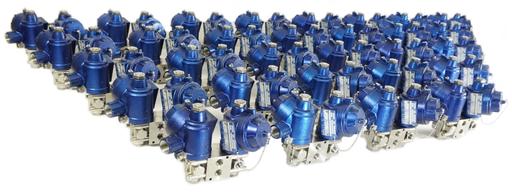
Open any solenoid valve datasheet and the first thing you will see is a pair of numbers: 2/2, 3/2, 5/2 or 5/3. This short notation tells you more about what the valve does than almost anything else on the page, and choosing the wrong one means a valve that cannot drive the actuator it was bought for.
This guide explains what the numbers mean, how the ports are identified, and what each of the four common configurations is used for. If you are reading valves on a drawing, our guide on solenoid valve symbols explains how they are represented on P&IDs.
How the Notation Works
The notation is always written as ports / positions.
• The first number is the number of working ports, the connections for supply, outlets and exhausts. Pilot and electrical connections are not counted. This is why a valve is also described by its number of "ways": a 3/2 valve is a three-way valve.
• The second number is the number of distinct switching positions the valve can hold. On a valve symbol, each position is drawn as a separate square.
So a 5/2 valve has five ports and two positions, and a 5/3 valve has the same five ports but three positions.
One point of confusion: in North America, five-port valves are often called four-way valves, because they have four flow paths. A "4-way" and a "5/2" valve are usually the same thing.
Port Numbering
Pneumatic valve ports are identified by numbers under ISO 5599-3, or by letters on older equipment:
| Number | Older letter | Function |
|---|---|---|
| 1 | P | Supply (pressure inlet) |
| 2 | A (or B) | Outlet / working port |
| 4 | B (or A) | Second outlet / working port |
| 3 | R (or EA) | Exhaust from port 2 |
| 5 | S (or EB) | Exhaust from port 4 |
| 12, 14 | Z, Y | Pilot signal ports: a signal at 12 connects 1 to 2; at 14, 1 to 4 |
Odd numbers are always supply or exhaust, even numbers are always outlets. Letter conventions vary between manufacturers, so always check against the datasheet when replacing a valve.
2/2 Solenoid Valves: On/Off Control
A 2/2 valve has an inlet (1), an outlet (2) and two positions: open and closed. It is the simplest and most widely used solenoid valve, acting as an electrically operated tap.
2/2 valves are made in two forms:
• Normally closed (NC): closed when de-energised, opens when the coil is energised. The most common type, and the fail-safe choice wherever flow must stop on power loss.
• Normally open (NO): open when de-energised, closes when energised. Used where flow must continue on power loss, such as cooling water supplies.
Because they simply start and stop flow, 2/2 valves are used across liquids, gases and steam: water and process isolation, fuel gas shut-off, dosing, filling and drain duties. They are available as direct acting valves, which work from zero pressure, or pilot operated (servo) valves, which use line pressure to open larger orifices but need a minimum pressure differential to operate.
Browse our range of two-way solenoid valves.
3/2 Solenoid Valves: Supply and Exhaust
A 3/2 valve has a supply (1), an outlet (2) and an exhaust (3), with two positions. In one position, supply is connected to the outlet; in the other, the outlet is connected to exhaust and the supply is blocked. This lets the valve both pressurise and vent whatever is connected to port 2, which a 2/2 valve cannot do.
Like 2/2 valves, 3/2 valves are made as normally closed (outlet vented when de-energised) or normally open (outlet pressurised when de-energised). Universal 3/2 valves can be connected either way, and can also select between two supplies or divert one supply between two outlets.
Typical applications include:
• Operating single-acting (spring return) pneumatic cylinders and actuators
• Piloting larger air-operated valves
• Venting an actuator to drive a process valve to its fail-safe position, as in emergency shutdown systems
• Diverting or mixing flow between two lines
Browse our range of three-way solenoid valves.
5/2 Solenoid Valves: Double-Acting Control
A 5/2 valve has a supply (1), two outlets (2 and 4) and two exhausts (3 and 5), with two positions:
• Position one: supply to port 2, port 4 exhausts through port 5.
• Position two: supply to port 4, port 2 exhausts through port 3.
This is exactly what a double-acting cylinder or actuator needs: air to one side and exhaust from the other, then reversed. Because each outlet has its own exhaust, fitting a flow regulator or silencer to each exhaust port allows the extend and retract speeds to be set independently.
5/2 valves come in two main forms, and the choice matters for fail-safe behaviour:
• Single coil, monostable: a spring or air return brings the valve back to its rest position when de-energised. On power loss, the actuator always returns to a known position.
• Double coil, bistable: a pulse to one coil moves the valve, and it stays there until the other coil is energised. On power loss, the actuator holds its last position. This "memory" suits applications where the actuator should not move on a power failure.
For quarter-turn valve actuators, 5/2 valves are widely available with NAMUR mounting, which bolts directly to the actuator without pipework. Some NAMUR valves, such as the Nadi D50–D52 range, are convertible between 3/2 and 5/2 operation, so one valve suits both spring return and double-acting actuators. Manual reset 5/2 valves, which need an operator to latch them after a trip, are used in safety and shutdown circuits.
Browse our range of five-way solenoid valves.
5/3 Solenoid Valves: Adding a Centre Position
A 5/3 valve has the same five ports as a 5/2 valve, but a third, centre position. It has two coils. Energising one coil gives the same flow path as one 5/2 position; energising the other gives the reverse. When neither coil is energised, springs return the spool to the centre, and what happens there depends on the centre type:
| Centre type | Ports in centre position | Effect on a double-acting actuator |
|---|---|---|
| Closed centre | All ports blocked | Air is trapped on both sides, so the actuator stops and holds position, including mid-stroke |
| Open (exhaust) centre | Ports 2 and 4 open to exhaust; supply blocked | Both sides vent, so the actuator is depressurised and free to move |
| Pressure centre | Supply connected to both 2 and 4; exhausts blocked | Both sides pressurised; used with check valves or for specific holding duties |
The centre position is what makes a 5/3 valve useful. A closed centre lets an actuator be stopped and held anywhere in its stroke, for example for positioning, or so a damper or valve stays put on power loss. An open centre releases all pressure, allowing an actuator to be moved by hand or safely maintained. Note that a closed centre holds position only as well as the cylinder seals and fittings allow; for long-term holding against load, a lock-up valve may also be needed.
Measure Monitor Control supplies 5/3 solenoid valves with closed and open centres, in 1/4" to 1/2" sizes and IP65 or IP67 Exd versions.
Quick Comparison and Choosing the Right Configuration
| Notation | Ports | Positions | What it does | Typical use |
|---|---|---|---|---|
| 2/2 | 1, 2 | 2 | Starts and stops flow | Isolation of liquids, gases and steam |
| 3/2 | 1, 2, 3 | 2 | Pressurises and vents one outlet | Single-acting actuators, piloting, shutdown venting |
| 5/2 | 1, 2, 3, 4, 5 | 2 | Reverses pressure and exhaust between two outlets | Double-acting cylinders and actuators |
| 5/3 | 1, 2, 3, 4, 5 | 3 | As 5/2, plus a centre position | Mid-stroke stopping, holding or venting |
To choose, start with the job:
1. Do you simply need to start and stop flow? Use a 2/2 valve, normally closed unless flow must continue on power loss.
2. Are you driving a single-acting, spring return actuator? Use a 3/2 valve.
3. Are you driving a double-acting actuator? Use a 5/2 valve, then decide what should happen on power loss: return to a known position (single coil) or stay put (double coil).
4. Do you need to stop mid-stroke, or vent both sides of the actuator? Use a 5/3 valve, and choose the centre type to suit.
Then confirm the media, pressure range, voltage, connection size, enclosure rating and any ATEX requirements. Our solenoid valve FAQs cover these points in more detail.
Summary
Solenoid valve notation is always ports / positions. A 2/2 valve starts and stops flow; a 3/2 valve pressurises and vents a single outlet, making it the choice for single-acting actuators; a 5/2 valve reverses pressure between two outlets to drive double-acting actuators; and a 5/3 valve adds a centre position to stop, hold or vent the actuator. Under ISO 5599-3, port 1 is always supply, even numbers are outlets and odd numbers are exhausts. To see how these valves appear on drawings, read our guide on solenoid valve symbols.
Browse our solenoid valve range, including two-way, three-way and five-way valves, or speak to our team about the right configuration for your application.