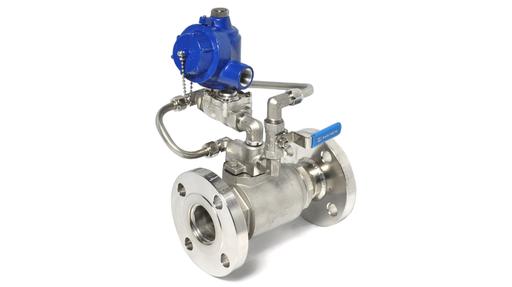
Solenoid valves and ball valves both open and close to control fluid flow. Beyond that shared purpose, they differ in almost every other respect: how they work, what they are suited to, what happens when power is lost, how they scale with pipe size, and what they cost to run. Choosing between them is not simply a matter of preference. The two types suit fundamentally different duties, and selecting the wrong one has real consequences for system reliability, energy consumption, and safety.
This guide covers both valve types in technical depth, explains where each excels and where each falls short, addresses the actuated ball valve as a third configuration that spans the gap between them, and provides a structured set of criteria for making the right selection.
How a Solenoid Valve Works
A solenoid valve is an electromechanical device. It combines a solenoid, which is an electromagnetic coil wound around a ferromagnetic core, with a valve body containing a closure element. When electrical current energises the coil, it generates a magnetic field that attracts a plunger or armature, moving it against a spring to open or close the valve port. When current is removed, the spring returns the plunger to its default position.
That default position defines the fail-safe behaviour of the valve. A normally closed (NC) solenoid valve remains shut when de-energised and requires continuous power to stay open. A normally open (NO) valve remains open when de-energised and requires power to close. This distinction is critical in safety-related applications and is discussed further below.
Direct-acting solenoid valves
In a direct-acting solenoid valve, the electromagnetic force of the coil directly moves the closure element. This means the valve will operate regardless of line pressure: it functions at zero differential pressure and at high differential pressure equally. Direct-acting designs are reliable and fast, but the coil must be sized to generate sufficient force to overcome line pressure directly. At larger sizes or higher pressures, this requires significantly larger coils, increasing power consumption and generating heat.
Servo-assisted (indirect-acting) solenoid valves
Servo-assisted designs use a small pilot orifice to exploit line pressure as the primary closing or opening force, with the solenoid only needing to trigger the pilot. This reduces the power required from the coil considerably, but introduces a minimum operating differential pressure requirement. The valve will not function correctly below this minimum pressure. This is a common point of misspecification: a servo-assisted valve specified for a system that sometimes operates at low or zero differential pressure will fail to open reliably.
Pilot-operated solenoid valves
Pilot-operated designs use a separate pilot valve to control a larger main valve. This approach is used in the largest solenoid valves, where direct actuation would require impractically large coils, and in the P05 high-flow axial solenoid valve available from Measure Monitor Control, which uses a Nadi pilot solenoid valve to operate an axial valve body from 2" to 12" for water, oil, and fuel service.
How a Ball Valve Works
A ball valve contains a spherical ball with a through-bore drilled along one axis. The ball is mounted on a stem connected to an operator, typically a lever or actuator. Rotating the stem by 90 degrees either aligns the bore with the flow path, giving full-bore flow, or turns it perpendicular to the flow, providing shut-off.
Ball valves are inherently mechanical devices. They have no coil, no spring return, and no inherent fail-safe behaviour in their basic form. A manually operated ball valve stays in whatever position it was last set. An actuated ball valve requires a spring-return actuator or a secondary power source to achieve a defined fail-safe position on loss of power or control signal.
Floating ball valves
In a floating ball design, the ball is held in position by the seat rings on either side. Line pressure pushes the ball against the downstream seat to create the seal. Floating ball valves provide reliable, low-cost shut-off and are standard for the majority of commercial and light industrial duties. At high pressures or large bore sizes, the seating load required to maintain seal integrity becomes too high for the seats to bear reliably, and a trunnion-mounted design is preferred.
Trunnion-mounted ball valves
Trunnion-mounted designs support the ball on fixed pivots top and bottom, independent of the seat rings. This prevents the ball from being pushed against the seats by line pressure, reducing operating torque and seat wear at high pressures. Trunnion designs also allow double-block-and-bleed configurations, where two independent seats provide dual isolation with a bleed between them, verifiable by pressure testing.
Solenoid Valves vs Ball Valves: The Key Differences
Operating principle and actuation
A solenoid valve is self-contained: the coil is integral to the valve, and no external actuator is required. Switching it requires only an electrical signal. A ball valve in its basic form requires manual operation. To automate a ball valve, a separate actuator must be added, either pneumatic or electric, turning it into an actuated ball valve assembly.
Speed of operation
Solenoid valves are fast. Direct-acting designs typically switch in milliseconds, servo-assisted designs in tens to hundreds of milliseconds. This response speed makes solenoid valves the preferred choice wherever rapid cycling is required: process dosing, emergency shut-down systems, pneumatic control circuits, and automated sequencing where cycle counts may run into millions over the valve's service life.
Actuated ball valves are considerably slower. Pneumatically actuated ball valves typically take two to ten seconds to operate; electrically actuated ball valves often require fifteen to sixty seconds or more for a full stroke. In many process isolation duties, rapid closure is undesirable because it causes water hammer: the damaging pressure surge generated by sudden flow arrest. For large-bore liquid systems, slower actuation is often specified deliberately.
Flow capacity and pipe size
Ball valves, particularly full-bore designs, present essentially no restriction to flow when open. The bore through the ball matches the pipe bore, giving a Cv (flow coefficient) close to that of an equivalent length of pipe. This makes ball valves suitable for very large pipe sizes and high-flow applications where pressure drop is a constraint.
Solenoid valves are inherently limited in flow capacity relative to their body size. They are practical up to around DN50 (2") in most direct-acting and servo-assisted configurations. Above this size, the cost and power consumption of direct-acting solenoid valves rises steeply, and a pilot-operated or axial design is generally the more practical solution. As a practical guide, for pipe sizes of DN25 (1") and above on liquid systems, the choice between a direct solenoid valve and an actuated ball valve should be reviewed carefully on a case-by-case basis.
Power requirements and energy consumption
Solenoid valves consume power continuously in most configurations. A normally closed solenoid valve requires power to stay open; a normally open valve requires power to stay closed. This continuous power draw generates heat in the coil, which over time can degrade coil insulation and reduce service life. Where a valve must remain in one position for extended periods, latch-type (bistable or impulse) solenoid valves that use a short pulse of power to switch and then hold position without continuous current are the practical solution.
A pneumatically actuated ball valve with a spring-return actuator, controlled by a solenoid pilot valve, consumes electrical power only during the brief period of switching. Once in position, neither the ball valve nor the actuator draws power. This can represent a significant operational cost advantage in applications where valves are open or closed for long periods.
Fail-safe behaviour
Fail-safe behaviour on loss of power or loss of control signal is a critical design consideration, particularly for safety-related applications governed by functional safety standards such as IEC 61511 (process industry) or IEC 61508 (general functional safety).
A solenoid valve has inherent fail-safe behaviour determined by its construction. A normally closed valve fails closed on loss of power: no additional components are required. A normally open valve fails open. The fail-safe position is predictable, reliable, and requires no additional energy or stored power.
A spring-return pneumatically actuated ball valve also has reliable fail-safe behaviour, with the spring returning the valve to its defined position on loss of compressed air or loss of the solenoid pilot signal. However, it depends on the compressed air supply being available, which introduces an additional dependency.
A double-acting pneumatically actuated ball valve has no inherent fail-safe position. It stays in its last commanded position on loss of compressed air, which may or may not be safe depending on the application. Fail-safe behaviour requires a spring-return actuator, stored air accumulators, or redundant supply, adding system complexity.
Media suitability
Solenoid valves are well suited to clean, low-viscosity liquids and gases where the flow path is compatible with the seal and body materials. They are not well suited to viscous media, slurries, or fluids containing significant particulate content. The orifice geometry in most solenoid valves is vulnerable to clogging and abrasion. A strainer upstream is recommended in all but the cleanest duties.
Ball valves handle a much wider range of media. Full-bore designs have no orifice restriction and pass particulates more readily than solenoid valves. They are suitable for slurries, viscous fluids, and media that would clog a solenoid valve. Seat materials can be selected for abrasion resistance, and lined ball valves are available for highly corrosive duties.
Body materials and environmental ratings
Both valve types are available in brass, bronze, carbon steel, and stainless steel bodies. For hazardous, corrosive, or cryogenic duties, 316 stainless steel is the standard specification. ATEX and IECEx certified solenoid valves are available for installation in potentially explosive atmospheres. NADI solenoid valves from Measure Monitor Control are certified to ATEX, IECEx, and GOST Ex, and operate down to -60°C, covering Arctic and cold climate duties where standard solenoid valves would fail.
The Actuated Ball Valve: Bridging the Gap
The actuated ball valve, consisting of a ball valve body with a pneumatic or electric actuator, occupies an important middle ground that the direct comparison between solenoid valves and ball valves sometimes obscures.
A pneumatically actuated ball valve controlled by a solenoid pilot valve combines the flow capacity and full-bore characteristics of the ball valve with the electrical controllability of the solenoid. The solenoid pilot valve switches compressed air to drive the actuator, requiring only a small electrical signal at the pilot stage while delivering full actuator force at the ball valve. This approach is the standard configuration for automated isolation duties on larger pipe sizes in process automation.
Measure Monitor Control supply actuated valve packages including pneumatic and electric actuated ball and butterfly valves, with options for ATEX certification, spring return or double-acting actuators, position feedback, and battery backup for defined fail-safe behaviour. Packages can be supplied as complete assemblies ready to install, with switchboxes, solenoid pilot valves, and position sensors integrated as a single unit.
Selection Summary
Key selection criteria compared across both types
| Consideration | Solenoid valve | Actuated ball valve |
|---|---|---|
| Pipe size | Up to DN50 typically | All sizes; best from DN25 up |
| Actuation speed | Very fast (ms to seconds) | Slower (seconds to minutes) |
| Flow capacity | Moderate; restricted at larger sizes | Full-bore; high Cv |
| Media | Clean liquids and gases | Wide range including viscous and particulate |
| Power (holding) | Continuous (unless bistable) | None — spring holds position |
| Fail-safe | Inherent (NC or NO) | Requires spring-return actuator |
| Compressed air needed | No | Yes (pneumatic type) |
| High cycle duty | Excellent | Moderate (actuator wear over time) |
| ATEX hazardous area | Available | Available with certified actuator |
| Typical duty | Fast switching, automation, pilot control | Process isolation, large bore, infrequent cycling |